
What Is Craps and Why Should You Learn It?
Craps is a dice game played in casinos around the world, and it is widely regarded as one of the most exciting games on the casino floor. Whether you are stepping into a land-based casino for the first time or exploring online craps tables from the comfort of your home, understanding how to play craps properly gives you the confidence to place smart bets and enjoy every roll of the dice.
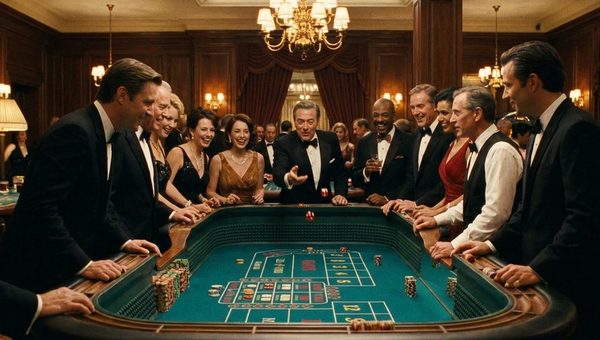
Unlike many casino games where you play against the dealer alone, craps creates a shared experience. Players gather around the table, cheer together, and react to every outcome. The energy is unmatched, and once you grasp the basics, you will see why craps has remained a favourite for centuries.
This guide walks you through everything you need to know — from your very first bet to advanced table dynamics. By the end, you will understand the come out roll, the most common bets, table positions, and how online craps compares to live play.
The Craps Table: Your Playing Field
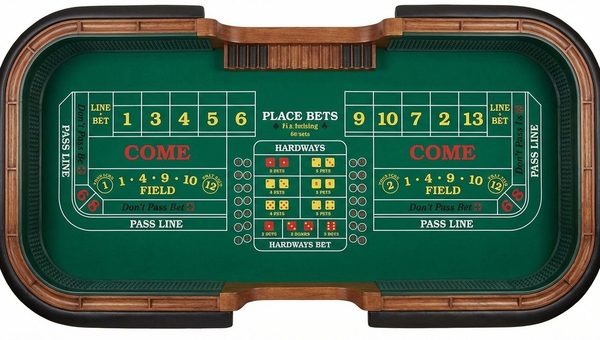
Before placing any bets, it helps to understand the craps table layout. The standard craps table is a large, oval-shaped surface covered in green felt. It is divided into three main sections:
The Left and Right Sides (Mirror Images)
Each side of the table is identical. They feature the Pass Line, Don’t Pass Bar, Come, Don’t Come, Field, and Place Bet areas. This mirrored design allows players on both ends to place the same bets.
The Centre Section
The centre of the table is reserved for proposition bets (also called prop bets). These include one-roll bets like Any Seven, Any Craps, and hardway bets. The stickman manages this area.
Key Areas to Know
- Pass Line: The most fundamental bet in craps. You place this before the come out roll.
- Don’t Pass Bar: The opposite of the Pass Line — you are betting against the shooter.
- Come/Don’t Come: Similar to Pass/Don’t Pass but placed after a point is established.
- Field: A one-roll bet on specific numbers (2, 3, 4, 9, 10, 11, 12).
- Place Bets (4, 5, 6, 8, 9, 10): Bets that a specific number will be rolled before a 7.
For a detailed visual breakdown, see our complete craps table layout guide.
The Crew: Who Runs the Craps Table
Every craps table is managed by a team of four casino staff members:
- Boxman: Sits at the centre of the table and supervises the entire game. The boxman watches over the chips and resolves any disputes.
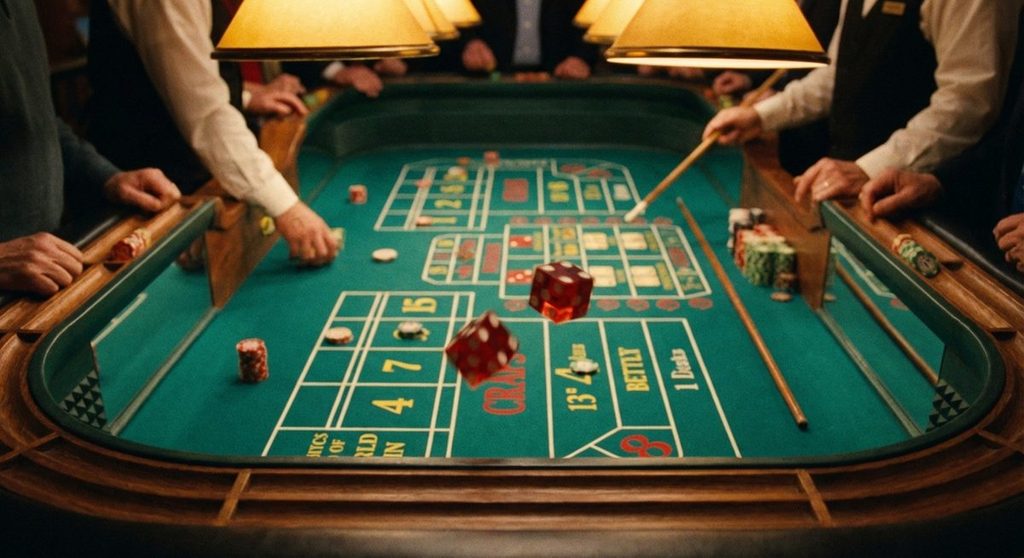
- Stickman: Stands across from the boxman, controls the dice with a long curved stick, announces the results of each roll, and manages centre proposition bets.
- Two Base Dealers: Each stands on one side of the table. They handle bets, pay winners, collect losing bets, and place Come/Don’t Come and Place bets for players.
At online craps tables, software handles all of these roles automatically, though live dealer craps games feature real staff via video stream.
Step-by-Step: How a Craps Round Works
Understanding the flow of a craps round is the key to playing confidently. Here is how it works from start to finish.
Step 1: The Come Out Roll
Every craps round begins with the come out roll. The shooter (the player rolling the dice) must place a bet on either the Pass Line or Don’t Pass Bar before rolling. Other players at the table do the same.
Three things can happen on the come out roll:
- Natural (7 or 11): Pass Line bets win immediately. Don’t Pass bets lose.
- Craps (2, 3, or 12): Pass Line bets lose immediately. Don’t Pass wins on 2 and 3. Rolling 12 is typically a push (tie) for Don’t Pass bettors.
- Point (4, 5, 6, 8, 9, or 10): The dealer places a puck on the number rolled. This establishes the point, and the game enters the point phase.
Step 2: The Point Phase
Once a point is established, the shooter continues rolling. The objective now depends on your bet:
- Pass Line bettors: Win if the point number is rolled again before a 7.
- Don’t Pass bettors: Win if a 7 is rolled before the point number.
The shooter keeps rolling until either the point is made (Pass Line wins) or a 7 appears (Don’t Pass wins, and this is called a seven-out). When a seven-out occurs, the dice pass to the next player.
Step 3: Resolution and New Round
After the round resolves, all bets are paid or collected, and a new come out roll begins. If the shooter made their point, they continue shooting. If they seven-out, the next player clockwise becomes the new shooter.
Essential Craps Bets Every Beginner Should Know
Craps offers dozens of betting options, but you only need to know a handful to play well. Here are the essential bets ranked from best to worst in terms of house edge.
Pass Line Bet (House Edge: 1.41%)
The Pass Line is the bread and butter of craps. You place it before the come out roll. It wins on a natural (7 or 11) and loses on craps (2, 3, or 12). If a point is established, it wins when the point is rolled again before a 7.
Don’t Pass Bet (House Edge: 1.36%)
The Don’t Pass is the mirror image of the Pass Line. It wins on 2 or 3 during the come out, pushes on 12, and loses on 7 or 11. During the point phase, it wins if a 7 comes before the point. While mathematically slightly better than the Pass Line, betting against the table can attract social pressure. Read our craps etiquette guide to understand the dynamics.
Come and Don’t Come Bets (House Edge: 1.41% / 1.36%)
These work exactly like Pass/Don’t Pass but are placed after a point is established. They essentially give you a fresh come out roll within the current round. Advanced players use Come bets to have multiple numbers working simultaneously.
Odds Bets (House Edge: 0%)
This is the best bet in the casino. After a point is established, you can place an additional bet behind your Pass Line or Don’t Pass bet called the Odds bet. It pays at true mathematical odds with zero house edge. The casino limits how much you can place (typically 3x, 4x, 5x, or even 100x your original bet depending on the casino).
Place Bets on 6 and 8 (House Edge: 1.52%)
Place bets let you bet on specific numbers (4, 5, 6, 8, 9, or 10) to be rolled before a 7. The 6 and 8 are the best Place bets because they have the lowest house edge at 1.52%. Numbers 4 and 10 carry a 6.67% house edge, making them far less attractive.
Field Bet (House Edge: 2.78% – 5.56%)
The Field bet wins on 2, 3, 4, 9, 10, 11, or 12. It pays even money on most numbers, with 2 and 12 typically paying double or triple. While it looks appealing because so many numbers win, the 5, 6, 7, and 8 (the most frequently rolled numbers) all lose. The house edge depends on whether 12 pays double (5.56%) or triple (2.78%).
For a complete breakdown of every bet and its mathematical edge, visit our craps dice combinations and probabilities guide.
The Odds Bet: The Best-Kept Secret in Craps
The Odds bet deserves special attention because it is the only bet in the entire casino that pays at true odds with zero house edge. Here is how it works:
- After placing a Pass Line bet and a point being established, you place additional chips directly behind your Pass Line bet.
- For Don’t Pass, you place the Odds bet next to your original wager (called Laying Odds).
- The payout depends on the point number:
| Point Number | Pass Line Odds Payout | Don’t Pass Odds Payout |
|---|---|---|
| 4 or 10 | 2:1 | 1:2 |
| 5 or 9 | 3:2 | 2:3 |
| 6 or 8 | 6:5 | 5:6 |
The more you wager on Odds relative to your Pass Line bet, the lower the combined house edge becomes. At 100x Odds, the combined house edge drops to just 0.02%.
Craps Bets to Avoid as a Beginner
While craps offers many exciting proposition bets, most of them carry a significant house edge. Here are the bets beginners should avoid:
- Any Seven (16.67% house edge): The single worst bet on the craps table.
- Any Craps (11.11%): Wins on 2, 3, or 12 but the edge is steep.
- Hard 4 and Hard 10 (11.11%): Betting that 4 or 10 will be rolled as doubles.
- Hard 6 and Hard 8 (9.09%): Slightly better but still unfavourable.
- Big 6 and Big 8 (9.09%): Identical to a Place bet on 6 or 8 but pays even money instead of 7:6. Never place this bet — always use the Place bet instead.
Stick to Pass/Don’t Pass with maximum Odds, and you will have one of the lowest house edges available in any casino game.
How to Play Craps Online vs. in a Land-Based Casino
Online craps follows exactly the same rules as live craps, but the experience differs in several important ways:
Advantages of Online Craps
- Pace: You control the speed. No waiting for other players or the crew.
- Minimum bets: Online tables often start at £0.10–£1, compared to £5–£25 in UK casinos.
- Free play: Most online craps games offer a demo mode so you can practise without risking money.
- No intimidation: Learn at your own pace without worrying about mistakes at a crowded table.
- Bonuses: Online casinos offer welcome bonuses that can boost your starting bankroll.
Advantages of Live Casino Craps
- Social atmosphere: The energy around a hot craps table is unmatched.
- Tactile experience: Physically rolling dice and stacking chips adds to the thrill.
- Live interaction: Chat with dealers and fellow players.
Live Dealer Craps Online
The best of both worlds is live dealer craps, available from providers like Evolution Gaming. You watch a real dealer via HD video stream while placing bets digitally. Evolution’s First Person Craps also offers an immersive 3D experience with realistic physics.
Craps Strategy Tips for Beginners
While craps is a game of chance, smart bet selection significantly impacts your expected returns over time. Here are the top strategy tips for new players:
- Always bet Pass Line + Maximum Odds. This gives you the lowest possible house edge.
- Alternatively, use Don’t Pass + Lay Odds for an even slightly better mathematical edge (1.36% base).
- Avoid proposition bets. Every centre-table bet carries a house edge above 9%.
- Set a bankroll limit. Decide how much you are willing to lose before sitting down and stick to it.
- Start with low-stakes online craps. Practise the bet mechanics and round flow at minimum stakes.
- Use Come bets to diversify. Having 2–3 numbers working gives you more action per roll without increasing the house edge.
- Never chase losses. Craps variance can swing wildly in short sessions. Accept cold streaks and walk away when your limit is reached.
Common Mistakes New Craps Players Make
Beginners frequently fall into these traps:
- Betting the Field every roll: It looks like a good bet because many numbers win, but the house edge is 2.78–5.56%.
- Placing Big 6 or Big 8: These pay even money when the Place bet on the same numbers pays 7:6. Always use Place bets instead.
- Ignoring Odds bets: Many beginners do not realise they can back their Pass Line bet with zero-edge Odds.
- Betting too many numbers: Having action on every number means you lose more when the 7 appears.
- Poor bankroll management: Craps tables are exciting, and it is easy to bet more than you planned.
Understanding Craps Dice Probabilities
Craps uses two six-sided dice, producing 36 possible combinations. Understanding these probabilities helps you make informed bets:
| Total | Combinations | Probability |
|---|---|---|
| 2 | 1 | 2.78% |
| 3 | 2 | 5.56% |
| 4 | 3 | 8.33% |
| 5 | 4 | 11.11% |
| 6 | 5 | 13.89% |
| 7 | 6 | 16.67% |
| 8 | 5 | 13.89% |
| 9 | 4 | 11.11% |
| 10 | 3 | 8.33% |
| 11 | 2 | 5.56% |
| 12 | 1 | 2.78% |
The number 7 is the most frequently rolled total, appearing in 6 out of 36 combinations. This is precisely why Pass Line bets win on 7 during the come out roll but lose to 7 during the point phase. For the full mathematical analysis, read our craps dice combinations guide.
Craps Terminology Quick Reference
Craps has its own unique language. Here are the most important terms to know before playing:
- Shooter: The player rolling the dice.
- Come Out Roll: The first roll of a new round.
- Point: The number (4, 5, 6, 8, 9, or 10) established on the come out roll.
- Natural: Rolling 7 or 11 on the come out roll.
- Craps: Rolling 2, 3, or 12 on the come out roll.
- Seven-Out: Rolling a 7 during the point phase (shooter loses and passes the dice).
- Hardway: Rolling a number as doubles (e.g., 4 as 2+2).
- Yo: Slang for 11, used to avoid confusion with “seven.”
- Snake Eyes: Rolling a 2 (both dice show 1).
- Boxcars: Rolling a 12 (both dice show 6).
For the complete glossary with 80+ terms, visit our craps terminology guide.
Frequently Asked Questions About How to Play Craps
What is the best bet in craps for beginners?
The Pass Line bet combined with maximum Odds is the best bet for beginners. The Pass Line has a house edge of just 1.41%, and the Odds bet behind it has zero house edge, making this combination one of the best wagers available in any casino game.
How many dice are used in craps?
Craps uses two standard six-sided dice. The shooter typically selects two from a set of five dice offered by the stickman. Together, the two dice can produce totals from 2 to 12 across 36 possible combinations.
What happens on the come out roll?
The come out roll is the first roll of a new craps round. If the shooter rolls 7 or 11, Pass Line bets win immediately. If 2, 3, or 12 is rolled, Pass Line bets lose. Any other number (4, 5, 6, 8, 9, 10) becomes the point, and the game moves to the point phase.
Can you play craps online in the UK?
Yes, craps is available at many UK-licensed online casinos. You can play standard digital craps, first-person craps with 3D graphics, and live dealer craps with real croupiers. All UK online casinos must hold a UKGC licence to operate legally.
What is the house edge in craps?
The house edge in craps varies dramatically depending on the bet. The best bets (Pass Line with Odds) have a combined house edge below 0.5%, whilst the worst bets (Any Seven) carry a house edge of 16.67%. Smart bet selection is crucial.
What does seven-out mean in craps?
Seven-out occurs when the shooter rolls a 7 during the point phase (after a point has been established). This ends the round — Pass Line bets lose, Don’t Pass bets win, and the dice pass to the next shooter. Seven-out is different from rolling a 7 on the come out roll, which is a win for Pass Line bettors.
Do I have to be the shooter in craps?
No. When it is your turn, you can decline to shoot and pass the dice to the next player. You can still place all the same bets without ever rolling the dice. Many experienced players prefer not to shoot and focus entirely on their betting strategy.
What is the difference between Pass and Don’t Pass?
The Pass Line bet wins when the shooter makes their point or rolls a natural (7 or 11). The Don’t Pass bet wins when the shooter sevens out or rolls craps (2 or 3) on the come out roll. Don’t Pass has a slightly lower house edge (1.36% vs. 1.41%) but goes against the table consensus. Learn more in our craps rules guide.
How long does a craps round last?
A craps round can last one roll (if the come out produces a natural or craps) or many rolls if a point is established. Statistically, the average number of rolls per shooter is about 8.5, but hot streaks of 30+ rolls do happen. Online craps rounds tend to be faster since there is no physical dice throwing.
What is the minimum bet at a craps table?
In UK land-based casinos, the minimum craps bet is typically £5 to £25 depending on the venue and time of day. Online craps tables often have minimums as low as £0.10 to £1, making them ideal for beginners who want to learn without significant financial risk.
Is craps a game of skill or luck?
Craps is fundamentally a game of chance — no technique can influence how the dice land. However, there is significant skill involved in bet selection. Choosing bets with low house edges (Pass Line + Odds) versus high house edge bets (proposition bets) dramatically affects your long-term results.
What are hardway bets in craps?
Hardway bets wager that a specific even number (4, 6, 8, or 10) will be rolled as doubles before it is rolled any other way or before a 7 appears. For example, Hard 8 means betting that 4+4 will be rolled before any other combination totalling 8 (like 3+5 or 2+6) and before a 7. These carry high house edges (9.09% to 11.11%).
Can I use a craps strategy to guarantee wins?
No strategy can guarantee wins in craps because the dice outcomes are random. However, using optimal bet selection (Pass/Don’t Pass with maximum Odds) minimises the house edge to near zero. Bankroll management and discipline are equally important for long-term enjoyment.
What is the puck on the craps table?
The puck is a disc that indicates whether the game is in the come out phase or point phase. When it shows “OFF” (black side), a new come out roll is about to happen. When it shows “ON” (white side) and is placed on a number, that number is the current point.
Where should I practise craps before playing for real money?
The best way to practise is with free online craps games. Most UK online casinos offer demo versions where you play with virtual chips. This lets you learn the table layout, bet types, and round flow without any financial risk. Once comfortable, start with low-stakes real money tables.