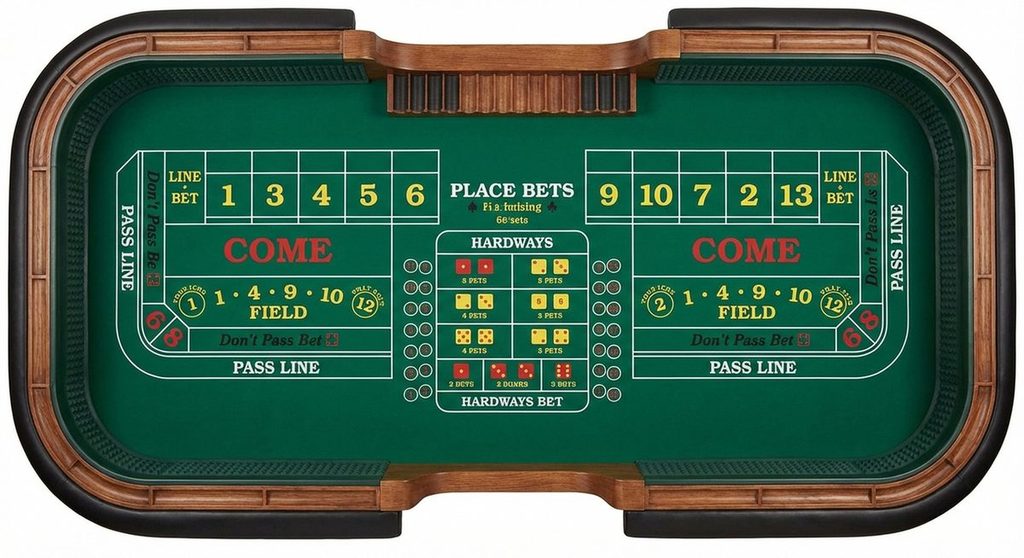

Understanding the Craps Table Layout
The craps table is one of the largest and most intricate surfaces in any casino. For first-time players, the sheer number of betting areas, numbers, and markings can feel overwhelming. But the layout is more logical than it appears — once you understand the three main sections and what each area represents, the table becomes intuitive.
This guide explains every section of the craps table layout in detail, from the Pass Line to the proposition bets in the centre. Whether you are preparing for your first visit to a UK casino or learning to navigate online craps interfaces, this breakdown covers everything you need.
The Three Main Sections of the Craps Table
A standard craps table measures approximately 12 feet long and 5 feet wide. It is divided into three distinct sections:
1. The Left Side and Right Side (Identical Mirror Images)
The two ends of the table are exact mirror images of each other. This design accommodates players standing on either side. Each side features:
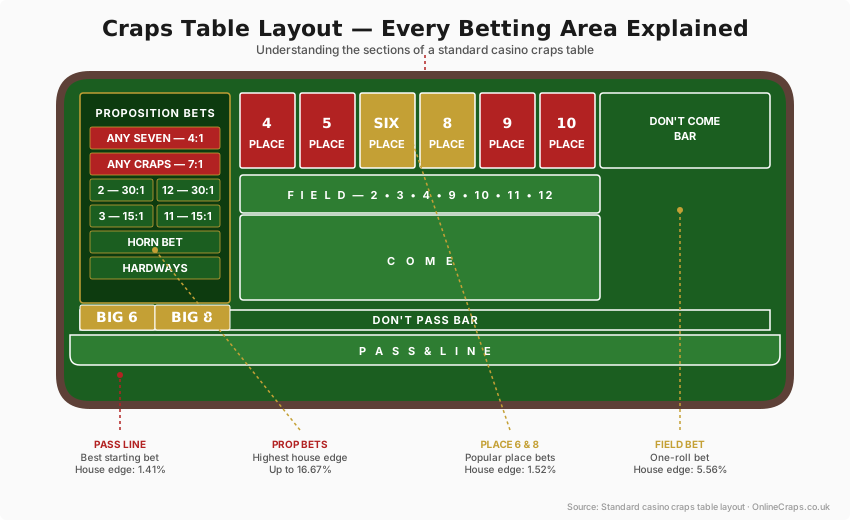
- Pass Line: A long strip running along the entire perimeter of the side. This is where you place the most fundamental bet in craps.
- Don’t Pass Bar: A narrower strip just above the Pass Line, marked “Don’t Pass Bar — Bar 12” (or sometimes Bar 2).
- Come: A large rectangular area above the Don’t Pass Bar where Come bets are placed.
- Don’t Come Bar: A smaller section within or adjacent to the Come area for Don’t Come wagers.
- Field: A prominent section listing the numbers 2, 3, 4, 9, 10, 11, and 12. Often decorated to highlight the double/triple payouts on 2 and 12.
- Place Bet Boxes: Six numbered boxes across the top showing 4, 5, SIX, 8, NINE, and 10 (note that 6 and 9 are spelled out to avoid confusion). These are where Place, Buy, and Lay bets are positioned.
- Big 6 and Big 8: Two rounded sections at the corner near the proposition area. These are among the worst bets on the table and are being phased out in many casinos.
2. The Centre Section (Proposition Bets)
The centre of the table is shared by all players and managed exclusively by the stickman. This area contains:
- Hardway Bets: Boxes for Hard 4, Hard 6, Hard 8, and Hard 10.
- One-Roll Propositions: Areas for Any Seven, Any Craps, specific number bets (Aces, Ace-Deuce, Yo, Boxcars).
- Horn Bet: A combination bet covering 2, 3, 11, and 12 in one wager.
- C & E (Craps and Eleven): Small circles for quick craps/yo combination bets.
The centre section carries the highest house edges on the table, ranging from 9.09% to 16.67%. Experienced players rarely use this area.
3. The Rail and Chip Rack
The padded rail surrounds the table and includes built-in grooves (the chip rack) where players store their chips. The rail also serves as the surface players lean against while playing.
Detailed Breakdown: The Pass Line Area
The Pass Line is the most prominent feature of the craps table layout. It runs along the entire inner perimeter of each side, making it easily accessible to every player. Key details:
- Placement: You place your chips directly on the Pass Line strip before the come out roll.
- Odds placement: After a point is established, you place Odds chips directly behind your Pass Line bet (slightly outside the line towards you).
- Colour: The Pass Line is typically outlined in white or a contrasting colour against the green felt.
- Contract status: Pass Line bets are contract bets — they cannot be removed during the point phase.
Detailed Breakdown: The Place Bet Boxes
The Place bet boxes sit at the top of each side, showing the numbers 4, 5, SIX, 8, NINE, and 10. These boxes serve multiple purposes:
For Place Bets
The dealer positions your chips in specific locations within each box to identify which player owns which bet. Your chip position corresponds to your standing position at the table.
For the ON/OFF Puck
When a point is established, the dealer places the ON puck (white side up) on the relevant number box. This indicates the current point to all players. When no point is active, the puck sits in the Don’t Come area with its black OFF side showing.
For Come Bet Points
When a Come bet establishes its own point, the dealer moves your Come bet chips from the Come area into the corresponding number box. The dealer tracks which chips belong to which Come bet.
Detailed Breakdown: The Field
The Field is positioned prominently between the Come area and the Pass Line on each side. Its design deliberately lists all the winning numbers to make it look attractive:
- Numbers displayed: 2, 3, 4, 9, 10, 11, 12
- The number 2 typically shows “DOUBLE” or “2x” underneath
- The number 12 shows “DOUBLE” or “TRIPLE” depending on the casino
- Missing numbers (5, 6, 7, 8) — the most frequently rolled — are not shown, which creates a visual illusion that the bet covers most outcomes
The Field is a self-service bet: you place and collect chips yourself without needing the dealer. This convenience, combined with its visual appeal, makes it one of the most popular (and most misunderstood) bets on the table.
The Crew Positions and Their Table Zones
Understanding where each crew member stands helps you know who to interact with for different bets:
- Boxman: Sits at the centre of the table on the casino side, directly opposite the stickman. Oversees the chip bank and game integrity.
- Stickman: Stands at the centre of the table on the player side. Controls dice movement and manages all centre proposition bets. Announces every roll result.
- Left Base Dealer: Manages all bets on the left side of the table (Place bets, Come/Don’t Come, Odds, payouts).
- Right Base Dealer: Manages all bets on the right side of the table (same duties as the left dealer for their section).
Player Positions and Chip Identification
In a land-based casino, each player’s standing position around the table corresponds to a specific chip placement zone within the Place bet and Come bet boxes. This is how dealers track whose bets belong to whom when multiple players have bets on the same numbers.
Players standing at position 1 (closest to the stickman on the left) will have their chips placed in the front-left corner of each box. Players at subsequent positions have their chips placed in corresponding zones moving clockwise. This system is invisible to most beginners but essential for accurate bet tracking.
Online Craps Table Layout Differences
Online craps tables replicate the physical layout with some practical differences:
- Single side: Online tables typically show only one side since there is only one player.
- Interactive labels: Hovering over betting areas often reveals bet names, payouts, and minimum/maximum stakes.
- Automatic calculations: The software calculates and displays potential payouts before you confirm your bet.
- Simplified centre: Some online versions combine or simplify proposition bets for easier navigation.
- Bet history: Online tables usually display recent roll results, which is not available at physical tables.
For a full introduction to the game, visit our how to play craps beginner’s guide.
Reading the Table: Numbers Spelled Out
One small but important detail: on the Place bet boxes, the numbers 6 and 9 are always spelled out as SIX and NINE (or displayed with a line underneath). This prevents confusion since 6 and 9 look identical when viewed from across the table. This convention is universal in both land-based and online craps layouts.
The Back Wall and Dice Landing Zone
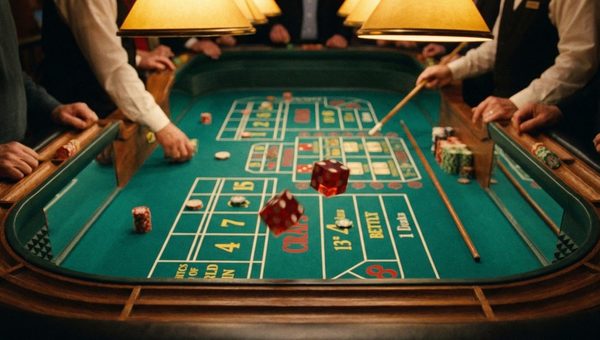
The far wall of each end of the table is lined with a rubber surface featuring a pyramid pattern (sometimes called alligator rubber). When the shooter throws the dice, they must hit this back wall. The pyramid shapes create random bouncing patterns, ensuring truly random outcomes. If the dice do not reach the back wall, the stickman may call “no roll” and ask the shooter to throw again.
Why Understanding the Layout Matters
Knowing the table layout gives you three practical advantages:
- Faster bet placement: You know exactly where to put your chips without hesitation.
- Better bet awareness: You can see what others are betting and understand why the table reacts the way it does.
- Avoiding bad bets: When you can identify the proposition bet area and Big 6/Big 8, you know to steer clear. Understanding why Place 6 at 7:6 beats Big 6 at even money is immediately obvious when you see both areas on the table.
Master the layout, and you will approach any craps table — online or in person — with total confidence. For the terminology used at the table, see our complete craps terminology glossary.
Frequently Asked Questions About the Craps Table Layout
Why are there two identical sides on a craps table?
The mirrored layout accommodates up to 16-20 players simultaneously. Each side operates independently, managed by its own base dealer. Both sides share the same come out roll and point, but having two sides means more players can access betting areas comfortably.
What is the difference between the Pass Line and Don’t Pass Bar?
The Pass Line runs along the outer edge and is for betting with the shooter. The Don’t Pass Bar is the narrower strip just inside the Pass Line, used for betting against the shooter. They are adjacent but represent opposite wagers with slightly different house edges (1.41% vs. 1.36%).
Why are 6 and 9 spelled out on the craps table?
The digits 6 and 9 are visually identical when rotated 180 degrees. Since players and dealers view the table from different angles, spelling them out (SIX and NINE) eliminates any ambiguity about which number a betting box represents.
Where exactly do I place my Odds bet on the table?
For Pass Line Odds, place your chips directly behind your Pass Line bet, slightly outside the Pass Line strip towards the rail. For Come Odds, hand your chips to the dealer and announce the amount — the dealer places them on top of your Come bet in the number box, slightly offset to distinguish them from the original Come bet.
What is the purpose of the pyramid rubber on the back wall?
The pyramid-patterned rubber (also called diamond rubber or alligator rubber) ensures randomness. When dice hit this surface, the angled pyramids cause unpredictable bouncing. Casino rules require the dice to strike this wall on every throw, preventing controlled shooting techniques.
Can I reach all parts of the table from any position?
No. You can place Pass Line, Don’t Pass, Field, and Come bets yourself because these areas are within reach. However, Place bets, Buy bets, Lay bets, and centre proposition bets must be placed by the dealer or stickman. Simply announce your bet and toss your chips towards the appropriate crew member.
What does the ON/OFF puck indicate?
The puck has two sides: white (ON) and black (OFF). When showing OFF, no point is established and the next roll is a come out. When showing ON and placed on a number box, that number is the current point. The puck is the most important visual indicator of the game’s current phase.
Where are the best seats at a craps table?
Most craps players stand rather than sit. The most popular positions are near the centre of the table (close to the stickman) for easy chip tossing, and at the ends for direct access to the Pass Line. There is no strategic advantage to any position since the game outcome is the same for everyone.
Why is the Big 6/Big 8 area being removed from some tables?
Big 6 and Big 8 pay even money (1:1) for a bet that 6 or 8 will be rolled before 7. The Place bet on 6 or 8 pays 7:6 for the exact same wager. Smart players never use Big 6/Big 8 because the Place bet is strictly superior. Some casinos have removed these areas to simplify the layout.
How is an online craps table different from a physical one?
Online tables typically show a single side (since only one player is active), include interactive tooltips that explain each betting area, display recent roll history, and automatically calculate payouts. The rules and bet types are identical — only the presentation differs. Live dealer online craps uses a real physical table viewed via video stream.
What are the numbers displayed in the centre of the table?
The centre section shows proposition bets: Hardways (Hard 4, 6, 8, 10), one-roll bets (Any Seven, Any Craps, individual numbers), Horn bets, and C&E bets. This area is managed exclusively by the stickman and contains the highest house edge bets on the table, ranging from 9.09% to 16.67%.
Is the craps table layout the same worldwide?
The standard layout is remarkably consistent worldwide. Minor variations exist — some Asian casinos add additional betting areas, some tables spell out payouts differently, and the bar number for Don’t Pass may be 2 instead of 12 in certain regions. UK tables follow the standard international layout found in Las Vegas and Macau.