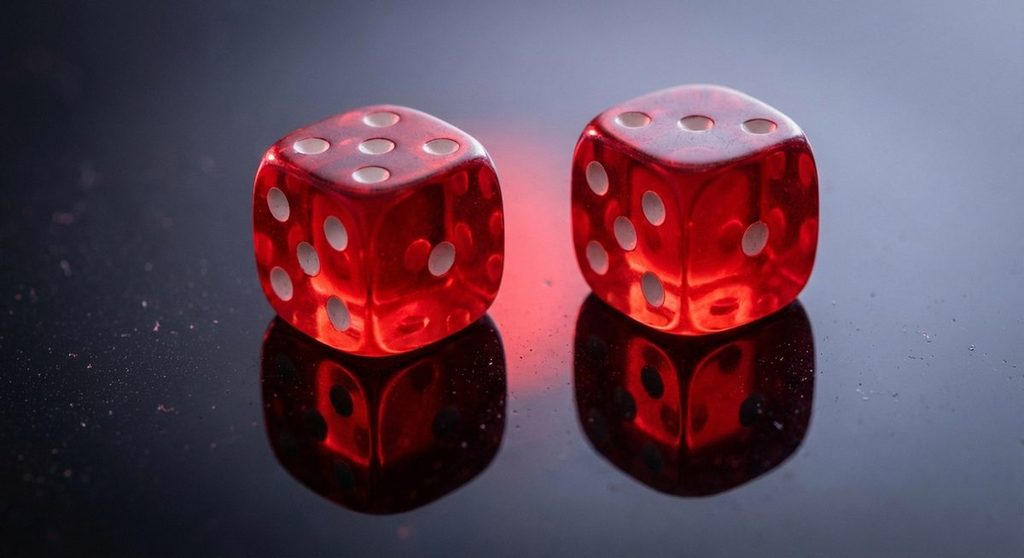

The Mathematics Behind Every Craps Roll
Craps is one of the few casino games where understanding the underlying mathematics directly improves your decision-making. Every bet on the craps table has a precise mathematical edge calculated from the 36 possible dice combinations. Knowing these probabilities lets you identify which bets offer genuine value and which ones drain your bankroll.
This guide provides the complete mathematical breakdown of craps dice combinations, probabilities, true odds, and house edges for every bet available on the table.
Two Dice, 36 Combinations
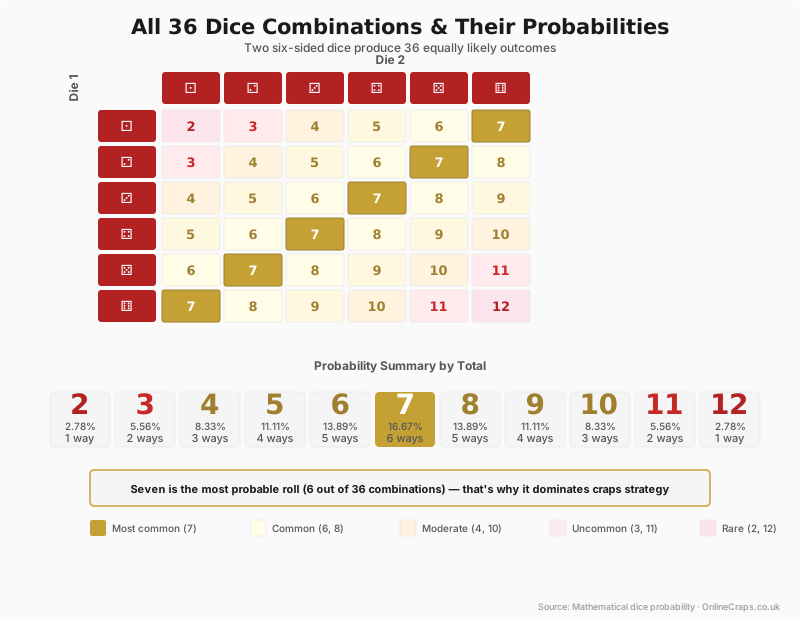
Craps uses two standard six-sided dice. Each die has faces numbered 1 through 6, and each face has an equal probability of landing face-up. When two dice are rolled together, there are exactly 36 possible combinations (6 × 6 = 36).
It is important to understand that the two dice are distinct. Rolling a 3 on die A and a 4 on die B is a different combination from rolling a 4 on die A and a 3 on die B — even though both total 7. This distinction is why some totals appear more frequently than others.
Complete Dice Combination Chart
| Total | Combinations | Ways to Roll | Probability | Odds Against |
|---|---|---|---|---|
| 2 | 1+1 | 1 | 2.78% | 35:1 |
| 3 | 1+2, 2+1 | 2 | 5.56% | 17:1 |
| 4 | 1+3, 2+2, 3+1 | 3 | 8.33% | 11:1 |
| 5 | 1+4, 2+3, 3+2, 4+1 | 4 | 11.11% | 8:1 |
| 6 | 1+5, 2+4, 3+3, 4+2, 5+1 | 5 | 13.89% | 31:5 |
| 7 | 1+6, 2+5, 3+4, 4+3, 5+2, 6+1 | 6 | 16.67% | 5:1 |
| 8 | 2+6, 3+5, 4+4, 5+3, 6+2 | 5 | 13.89% | 31:5 |
| 9 | 3+6, 4+5, 5+4, 6+3 | 4 | 11.11% | 8:1 |
| 10 | 4+6, 5+5, 6+4 | 3 | 8.33% | 11:1 |
| 11 | 5+6, 6+5 | 2 | 5.56% | 17:1 |
| 12 | 6+6 | 1 | 2.78% | 35:1 |
Why 7 Is the Most Important Number in Craps
The number 7 dominates craps because it can be formed in more ways (6 combinations) than any other total. This has profound implications:
- Come out roll: 7 is the most likely outcome, which is why Pass Line wins on 7 during the come out.
- Point phase: During the point phase, 7 is always more likely to appear than any single point number. This is why the casino has an edge on Pass Line bets — the 7 will statistically appear before the point more often than not for most point numbers.
- Place bets: Every Place bet is essentially a race between your chosen number and 7. The odds always favour 7.
7 vs. Each Point Number
| Point | Ways to Roll Point | Ways to Roll 7 | Odds Against Making Point |
|---|---|---|---|
| 4 | 3 | 6 | 2:1 against |
| 5 | 4 | 6 | 3:2 against |
| 6 | 5 | 6 | 6:5 against |
| 8 | 5 | 6 | 6:5 against |
| 9 | 4 | 6 | 3:2 against |
| 10 | 3 | 6 | 2:1 against |
Points 6 and 8 are the easiest to make because they each have 5 ways to be rolled versus 6 ways for 7 — nearly a coin flip. Points 4 and 10 are the hardest, with only 3 ways to roll versus 6 for 7, making them twice as likely to lose.
Hardway Probabilities
Hardway bets wager that an even number will be rolled as a double before it appears as a non-double or before 7 is rolled.
| Hard Number | Hard Combinations | Easy Combinations | Ways for 7 | True Odds | Casino Pays | House Edge |
|---|---|---|---|---|---|---|
| Hard 4 (2+2) | 1 | 2 | 6 | 8:1 | 7:1 | 11.11% |
| Hard 6 (3+3) | 1 | 4 | 6 | 10:1 | 9:1 | 9.09% |
| Hard 8 (4+4) | 1 | 4 | 6 | 10:1 | 9:1 | 9.09% |
| Hard 10 (5+5) | 1 | 2 | 6 | 8:1 | 7:1 | 11.11% |
Complete House Edge Table for Every Craps Bet
This is the definitive reference for evaluating any bet on the craps table.
| Bet | True Odds | Casino Pays | House Edge |
|---|---|---|---|
| Pass Line | 251:244 | 1:1 | 1.41% |
| Don’t Pass | 976:949 | 1:1 | 1.36% |
| Come | 251:244 | 1:1 | 1.41% |
| Don’t Come | 976:949 | 1:1 | 1.36% |
| Odds (any point) | Varies | True odds | 0.00% |
| Place 6 or 8 | 6:5 | 7:6 | 1.52% |
| Place 5 or 9 | 3:2 | 7:5 | 4.00% |
| Place 4 or 10 | 2:1 | 9:5 | 6.67% |
| Buy 4 or 10 | 2:1 | 2:1 minus 5% vig | 4.76% |
| Lay 4 or 10 | 1:2 | 1:2 minus 5% vig | 2.44% |
| Big 6 / Big 8 | 6:5 | 1:1 | 9.09% |
| Field (2x on 12) | — | Various | 5.56% |
| Field (3x on 12) | — | Various | 2.78% |
| Any Seven | 5:1 | 4:1 | 16.67% |
| Any Craps | 8:1 | 7:1 | 11.11% |
| Hard 6 / Hard 8 | 10:1 | 9:1 | 9.09% |
| Hard 4 / Hard 10 | 8:1 | 7:1 | 11.11% |
| Yo (11) | 17:1 | 15:1 | 11.11% |
| Aces (2) | 35:1 | 30:1 | 13.89% |
| Boxcars (12) | 35:1 | 30:1 | 13.89% |
| Horn Bet | — | Various | 12.50% |
Pass Line Probability Breakdown
The Pass Line is the most popular bet in craps. Here is exactly how the 1.41% house edge is calculated:
Come Out Roll Outcomes (36 rolls)
- Win on 7: 6/36 = 16.67%
- Win on 11: 2/36 = 5.56%
- Lose on 2: 1/36 = 2.78%
- Lose on 3: 2/36 = 5.56%
- Lose on 12: 1/36 = 2.78%
- Point established: 24/36 = 66.67%
Point Phase Probabilities
- Point 4 or 10 (probability of establishing: 3/36 each): Win 3/9 = 33.33%
- Point 5 or 9 (probability: 4/36 each): Win 4/10 = 40.00%
- Point 6 or 8 (probability: 5/36 each): Win 5/11 = 45.45%
Combined Pass Line Win Probability
Adding the come out wins and point phase wins together: the overall Pass Line win probability is 49.29%. The lose probability is 50.71%. The difference (1.41%) is the house edge.
The Odds Bet: Zero House Edge Explained
The Odds bet pays at the exact mathematical probability of the outcome, giving the casino no advantage. Here is why:
| Point | Ways to Win | Ways to Lose (7) | True Odds | Pass Odds Payout |
|---|---|---|---|---|
| 4 or 10 | 3 | 6 | 2:1 against | 2:1 |
| 5 or 9 | 4 | 6 | 3:2 against | 3:2 |
| 6 or 8 | 5 | 6 | 6:5 against | 6:5 |
Because the payout exactly matches the true odds, the expected value of every Odds bet is exactly zero. The more you bet on Odds relative to your Pass Line bet, the lower your overall house edge becomes.
Combined House Edge with Different Odds Multiples
| Odds Multiple | Combined House Edge (Pass + Odds) |
|---|---|
| 1x Odds | 0.85% |
| 2x Odds | 0.61% |
| 3-4-5x Odds | 0.37% |
| 5x Odds | 0.33% |
| 10x Odds | 0.18% |
| 20x Odds | 0.10% |
| 100x Odds | 0.02% |
Field Bet Mathematics
The Field bet appears attractive because 7 of the 11 possible totals win. But probabilities tell a different story:
- Winning numbers: 2 (1 way), 3 (2 ways), 4 (3 ways), 9 (4 ways), 10 (3 ways), 11 (2 ways), 12 (1 way) = 16 ways
- Losing numbers: 5 (4 ways), 6 (5 ways), 7 (6 ways), 8 (5 ways) = 20 ways
Despite covering more numbers, the Field loses on 20 out of 36 rolls (55.56%). The double/triple payouts on 2 and 12 partially compensate, but the house edge remains 2.78% (with triple 12) or 5.56% (with double 12).
Expected Value Per £100 Wagered
To put house edges in practical terms, here is what you can expect to lose per £100 wagered on each bet over the long run:
| Bet | Expected Loss per £100 |
|---|---|
| Odds Bet | £0.00 |
| Don’t Pass/Don’t Come | £1.36 |
| Pass Line/Come | £1.41 |
| Place 6 or 8 | £1.52 |
| Field (3x on 12) | £2.78 |
| Place 5 or 9 | £4.00 |
| Field (2x on 12) | £5.56 |
| Place 4 or 10 | £6.67 |
| Hard 6 / Hard 8 | £9.09 |
| Big 6 / Big 8 | £9.09 |
| Hard 4 / Hard 10 | £11.11 |
| Any Craps | £11.11 |
| Yo (11) | £11.11 |
| Horn Bet | £12.50 |
| Aces (2) / Boxcars (12) | £13.89 |
| Any Seven | £16.67 |
The difference is stark: betting £100 on Pass Line with Odds loses roughly £0.85, while the same £100 on Any Seven loses £16.67. Over hundreds of bets, this compounds dramatically.
Practical Application: Which Bets to Choose
Based purely on mathematics, the optimal craps strategy is clear:
- Best overall: Don’t Pass + maximum Lay Odds (combined edge as low as 0.02% at 100x).
- Best with-the-shooter: Pass Line + maximum Odds (combined edge as low as 0.02% at 100x).
- Best Place bets: Place 6 and Place 8 only (1.52% edge — acceptable).
- Acceptable: Come/Don’t Come with Odds (1.41%/1.36% before Odds).
- Avoid: Everything else (house edge above 2.78%).
For strategy tips on applying this knowledge, see our how to play craps guide. For the rules governing each bet, check our craps rules explained article.
Frequently Asked Questions About Craps Dice Combinations
How many possible outcomes are there when rolling two dice?
There are exactly 36 possible outcomes. Each die has 6 faces, and since the dice are independent, you multiply: 6 × 6 = 36. These range from (1,1) totalling 2 to (6,6) totalling 12, with 7 being the most common total appearing in 6 of the 36 combinations.
Why is 7 the most commonly rolled number in craps?
Seven has more dice combinations (6) than any other total because it sits at the mathematical centre of the distribution. The combinations are: 1+6, 2+5, 3+4, 4+3, 5+2, and 6+1. Every pair of numbers that sums to 7 uses one number from the lower half (1-3) and one from the upper half (4-6), maximising the number of possible pairings.
What are the odds of rolling any specific number in craps?
It depends on the number. A 2 or 12 has a 1/36 (2.78%) chance, a 3 or 11 has 2/36 (5.56%), a 4 or 10 has 3/36 (8.33%), a 5 or 9 has 4/36 (11.11%), a 6 or 8 has 5/36 (13.89%), and 7 has 6/36 (16.67%). The distribution is symmetrical around 7.
What is the probability of making each point number?
Point 6 or 8: 45.45% chance of making it. Point 5 or 9: 40.00%. Point 4 or 10: 33.33%. These probabilities are calculated by comparing the number of ways to roll the point versus the number of ways to roll a 7.
Why does the Odds bet have zero house edge?
The Odds bet pays at the exact mathematical (true) odds of the outcome occurring. For point 4 or 10, true odds are 2:1 against, and the bet pays 2:1. For point 5 or 9, true odds are 3:2, and it pays 3:2. For point 6 or 8, true odds are 6:5, and it pays 6:5. Because the payout perfectly matches the probability, there is no mathematical advantage for either side.
How does the house edge on Pass Line work mathematically?
On the come out roll, Pass Line wins 22.22% (7 or 11) and loses 11.11% (2, 3, 12), giving an initial advantage. But when a point is established (66.67% of the time), the shooter is always more likely to seven-out than make the point. This disadvantage during the point phase slightly exceeds the come out advantage, resulting in an overall loss rate of 50.71% versus a win rate of 49.29% — a 1.41% house edge.
What is the probability of rolling snake eyes (2)?
Snake eyes (1+1) has a probability of 1/36 or approximately 2.78%. This means on average, you will see snake eyes once every 36 rolls. In practical terms, at a busy craps table rolling about 100 times per hour, snake eyes will appear roughly 2-3 times per hour.
How many rolls does an average craps round last?
Statistically, the average number of rolls per shooter is approximately 8.53. This accounts for the 33.33% chance of the round ending on the come out (natural or craps) and the variable length of the point phase. Some rounds last 1 roll, while extended hot streaks can exceed 50 rolls.
Are the probabilities different in online craps versus live craps?
No. Online craps uses a certified random number generator (RNG) that produces outcomes with the same mathematical probabilities as physical dice. UK-regulated online casinos must have their RNGs independently tested and certified to ensure fair play. The probabilities are identical whether you are rolling physical dice or clicking a button.
What is the probability of a specific hardway occurring?
Each hardway combination has a 1/36 (2.78%) probability per roll. However, the hardway bet is not a one-roll bet — it wins only if the hard combination appears before the easy way or a 7. For Hard 6 or Hard 8, the probability of winning the bet is 1/11 (9.09%). For Hard 4 or Hard 10, it is 1/9 (11.11%).
How long would it take to see every possible dice combination?
This is a version of the coupon collector problem. On average, you would need approximately 150 rolls to observe all 36 distinct dice combinations at least once. At a typical live craps pace of 100 rolls per hour, this would take roughly 90 minutes.
Can dice be loaded or biased to change these probabilities?
Casino dice are precision-manufactured to extremely tight tolerances (within 1/10,000 of an inch) with sharp edges and transparent material to prevent hidden weights. Casinos also rotate dice regularly and inspect them under UV light. While theoretically possible to bias dice, casino safeguards make this practically impossible. Online craps eliminates this concern entirely through RNG technology.