
Why Craps Strategy Matters More Than You Think
Craps is one of the few casino games where your choice of bets dramatically affects the house edge. A player making Pass Line bets with full odds faces a combined house edge well below 1%, whilst someone throwing chips on proposition bets hands the casino more than 11% on every wager. The difference between a disciplined craps player and an uninformed one is enormous — and that difference comes down to strategy.
This guide breaks down the most effective craps strategies used by experienced players, analyses the mathematics behind each approach, and helps you build a betting plan that maximises your time at the table whilst minimising the casino’s advantage. Whether you play at land-based casinos or online craps tables, these principles apply universally.
Understanding the House Edge in Craps
Before diving into specific strategies, you need to understand what you are fighting against. The house edge is the mathematical advantage the casino holds over players on every bet. In craps, this edge varies wildly depending on which bets you choose.
Best Bets by House Edge
| Bet | House Edge | Classification |
|---|---|---|
| Odds Bet (behind Pass/Don’t Pass) | 0.00% | Excellent |
| Don’t Pass / Don’t Come | 1.36% | Excellent |
| Pass Line / Come | 1.41% | Excellent |
| Place 6 or 8 | 1.52% | Very Good |
| Place 5 or 9 | 4.00% | Fair |
| Field (triple on 12) | 2.78% | Fair |
| Place 4 or 10 | 6.67% | Poor |
| Hardways (6 or 8) | 9.09% | Poor |
| Hardways (4 or 10) | 11.11% | Bad |
| Any Seven | 16.67% | Terrible |
The single most important strategic principle in craps is simple: stick to bets with a house edge below 2%. This immediately narrows your focus to the Pass Line, Don’t Pass, Come, Don’t Come, Place 6/8, and — most importantly — the Odds bet.
For a complete mathematical breakdown of every bet’s edge, see our craps house edge comparison guide.
The Foundation: Pass Line with Maximum Odds
If you learn only one craps strategy, let it be this: place a Pass Line bet and back it with the maximum Odds bet the table allows. This is the single most effective way to play craps, and it is the foundation upon which nearly every advanced strategy is built.
How It Works
- Place a minimum bet on the Pass Line before the come out roll.
- If a point is established (4, 5, 6, 8, 9, or 10), place an Odds bet behind your Pass Line bet.
- The Odds bet pays at true mathematical odds — the casino takes zero edge on this portion of your wager.
Why Maximum Odds Are Critical
The more you place on the Odds bet relative to your Pass Line bet, the lower your overall house edge becomes. Here is the combined house edge based on different odds multiples:
| Odds Multiple | Combined House Edge |
|---|---|
| No Odds (flat bet only) | 1.41% |
| 1x Odds | 0.85% |
| 2x Odds | 0.61% |
| 3x-4x-5x Odds | 0.37% |
| 5x Odds | 0.33% |
| 10x Odds | 0.18% |
| 20x Odds | 0.10% |
| 100x Odds | 0.02% |
At 3x-4x-5x odds (the most common offering at UK online casinos), your combined house edge drops to just 0.37%. That is better than almost every bet in blackjack, roulette, or baccarat.
For a deeper look at the Pass Line bet itself, read our complete Pass Line bet guide.
The Conservative Strategy: Don’t Pass with Laying Odds
The Don’t Pass bet with Laying Odds is the mathematically optimal craps strategy. The base house edge of 1.36% is slightly lower than the Pass Line’s 1.41%, and when you add Laying Odds, you reduce it even further.
Why Some Players Avoid It
Despite being the better mathematical choice, Don’t Pass betting (also called “playing the dark side”) has social implications. You are effectively betting against the shooter and the rest of the table. When the table cheers a point being made, you lose. When a seven-out occurs and groans fill the air, you collect.
At online craps tables, this social pressure disappears entirely, making Don’t Pass an excellent default strategy for digital play.
Laying Odds vs Taking Odds
When you Lay Odds on a Don’t Pass bet, you are betting more to win less — because the odds favour you at this point. For example, if the point is 4, you lay £2 to win £1 (since a 7 is twice as likely to appear as a 4). The casino pays true odds, meaning zero house edge on the Odds portion.
Learn more in our Don’t Pass bet strategy guide.
The 3-Point Molly: A Disciplined Multi-Number Strategy
The 3-Point Molly is one of the most popular intermediate craps strategies. It gives you three numbers working at all times whilst keeping the house edge extremely low.
How to Execute the 3-Point Molly
- Step 1: Place a Pass Line bet. After the point is set, take maximum Odds.
- Step 2: Place a Come bet. When it travels to a number, take maximum Odds on the Come bet.
- Step 3: Place a second Come bet. When it travels, take maximum Odds again.
- Step 4: Stop. You now have three numbers with Odds. Do not place any more bets.
- Step 5: If a Come bet wins, replace it with a new Come bet to keep three numbers working.
Why the 3-Point Molly Works
With three numbers covered by Odds bets, you have multiple ways to win on any given roll. The combined house edge across all your active bets remains below 0.5% (assuming 3x-4x-5x odds). You benefit from the frequency of hitting numbers whilst keeping the casino’s edge negligible.
The discipline required is in stopping at three. Many players get excited and add more bets, but each additional bet without odds backing increases your overall exposure. Read our complete 3-Point Molly guide for detailed execution tips.
The Iron Cross Strategy: Covering Nearly Every Roll
The Iron Cross (also called the Field and Place strategy) is a popular approach that wins on almost every roll of the dice. Here is how it works:
- Place bets on 5, 6, and 8.
- Place a Field bet.
With these four bets active, you win on every number except 7. That means you win on 30 out of 36 possible dice combinations — an 83.3% win rate per roll.
The Catch
Despite the high hit frequency, the Iron Cross carries a combined house edge of approximately 3.87%. This is because the Field bet (2.78% or 5.56% depending on payouts) and Place 5 (4.00%) drag up the average. When a 7 appears, you lose all four bets simultaneously, which wipes out several winning rolls.
The Iron Cross is best used as a short-term strategy — a quick hit-and-run approach where you set a modest win goal, reach it, and pull your bets down. It is not suitable for extended sessions. See our Iron Cross strategy analysis for simulation data and expected results.
Place Betting the 6 and 8: The Simple Grind
If you want a straightforward strategy that requires minimal decision-making, placing the 6 and 8 is hard to beat. These two numbers are each rolled 5 out of 36 times (13.89% each), making them the most frequently rolled numbers after 7.
The Mathematics
- Place 6 pays 7:6 (bet in multiples of £6)
- Place 8 pays 7:6 (bet in multiples of £6)
- House edge: 1.52% on each
- Combined probability of hitting either number before a 7: 10/16 = 62.5%
This strategy works well for players who want steady, low-risk action. You place your bets, wait for 6s and 8s, and collect 7:6 payouts. When a 7 appears, you lose both bets and start again.
For a detailed analysis, read our Place Bets strategy guide.
Regression Strategy: Press Then Regress
The regression strategy is a bankroll management technique that works well with Place bets. The idea is to start with higher bets, collect a win, then reduce (regress) your bets to lock in profit.
Example with Place 6 and 8
- Start with £30 on the 6 and £30 on the 8 (total: £60 at risk).
- When either hits, you collect £35 (7:6 payout on £30).
- Immediately regress both bets to £12 each (£24 total at risk).
- You have locked in £11 profit (£35 won minus £24 reduction) and now have £24 working at minimal risk.
- Any subsequent wins on the regressed bets are pure profit.
This strategy does not change the house edge, but it does help manage variance and protect your bankroll during longer sessions.
Bankroll Management: The Unspoken Strategy
No discussion of craps strategy is complete without addressing bankroll management. Even with the best bets, craps is a negative expectation game — the casino holds a mathematical edge on every wager except the Odds bet. Proper bankroll management ensures you can weather the inevitable losing streaks and play long enough to enjoy the game.
Session Bankroll Guidelines
| Strategy | Minimum Session Bankroll | Recommended |
|---|---|---|
| Pass Line + Odds only | 30x minimum bet | 50x minimum bet |
| 3-Point Molly | 50x minimum bet | 80x minimum bet |
| Iron Cross | 40x minimum bet | 60x minimum bet |
| Place 6 and 8 | 20x minimum bet | 40x minimum bet |
Win Goals and Loss Limits
Set a win goal of 30-50% of your session bankroll. If you bring £200 to the table, aim to leave when you reach £260-£300. Similarly, set a loss limit — typically your entire session bankroll. When you hit either threshold, walk away. Discipline is what separates strategic players from gamblers chasing losses.
Strategies to Avoid: Common Traps
Certain betting approaches are marketed as winning strategies but are mathematically flawed. Understanding why they fail is just as important as knowing what works.
The Martingale System
The Martingale involves doubling your bet after every loss, with the theory that one win recovers all previous losses plus a small profit. In craps, this is typically applied to even-money bets like Pass Line.
Why it fails: Table limits cap how many times you can double. A £10 minimum bet reaches the £5,000 table limit after just 9 consecutive losses (£10, £20, £40, £80, £160, £320, £640, £1,280, £2,560). Nine losses in a row on the Pass Line happens approximately once every 550 sequences — not rare enough to ignore.
Dice Control / Dice Setting
Some players claim they can influence dice outcomes through specific grips and throwing techniques. Whilst the theory is fascinating, no controlled scientific study has ever demonstrated consistent dice influence in casino conditions. The randomness of the bounce off the back wall, required by most casinos, effectively negates any grip advantage.
Betting Systems Based on Streaks
Every roll of the dice is independent. The dice have no memory of previous outcomes. A table that has seen five consecutive 7s on the come out roll is no more or less likely to produce a sixth. Adjusting your bets based on perceived hot or cold streaks has no mathematical basis.
Online Craps Strategy Adjustments
Playing craps online introduces several strategic considerations that differ from live casino play.
Advantages of Online Play
- Lower minimums: Online tables often start at £1 or even £0.50, allowing you to take maximum odds relative to your bankroll.
- No social pressure: Don’t Pass betting is consequence-free when no one is watching.
- Pace control: You control when the dice roll, giving you time to calculate and place bets carefully.
- Bonuses: Casino welcome offers can extend your bankroll, though always check wagering requirements for table games (craps often contributes only 5-10% towards wagering).
Disadvantages to Consider
- Speed: Online rolls happen faster, which can accelerate losses if you are not disciplined.
- Odds multiples: Some online craps games limit odds to 2x or 3x, reducing your ability to lower the house edge.
- RNG vs Live: Standard online craps uses a random number generator. If you prefer watching real dice, choose live dealer craps instead.
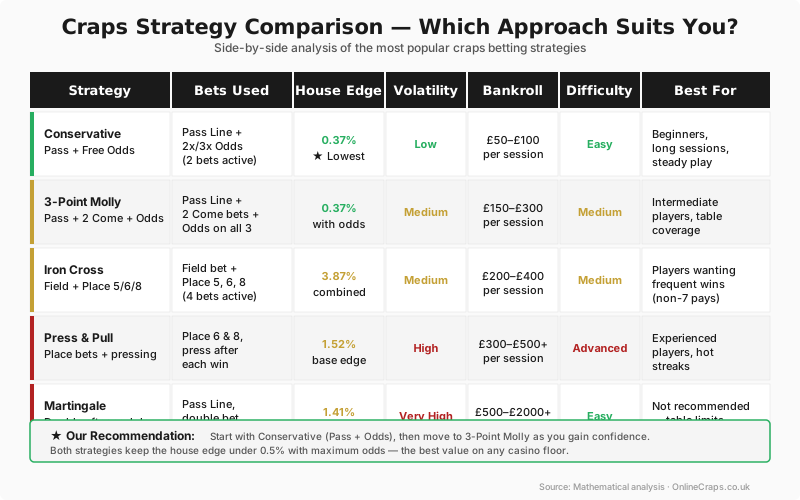
Strategy Comparison: Which Approach Suits You?
| Strategy | House Edge | Complexity | Volatility | Best For |
|---|---|---|---|---|
| Pass Line + Max Odds | 0.37%* | Low | Medium | Beginners, long sessions |
| Don’t Pass + Lay Odds | 0.34%* | Low | Medium | Online players, maths-focused |
| 3-Point Molly | 0.40%* | Medium | Medium | Intermediate players |
| Place 6 and 8 | 1.52% | Very Low | Low | Casual players, steady action |
| Iron Cross | 3.87% | Low | High | Short sessions, hit-and-run |
| Regression | 1.52% | Medium | Medium | Bankroll protection |
*Combined house edge assumes 3x-4x-5x odds
Building Your Personal Craps Strategy
The best craps strategy is one you can execute consistently without deviating under pressure. Here is a framework for building your approach:
- Choose your core bet: Pass Line or Don’t Pass — pick one and stick with it.
- Maximise Odds: Always take or lay the maximum odds the table permits.
- Set your bankroll: Bring enough to sustain 50+ betting rounds at your chosen level.
- Define your limits: Set a win goal (30-50% of bankroll) and a loss limit (100% of session bankroll).
- Add complexity gradually: Once comfortable, consider adding Come bets (3-Point Molly) or Place 6/8.
- Avoid temptation: Never make proposition bets, hardway bets, or field bets as part of a long-term strategy.
For a comprehensive list of every craps bet and its mathematical properties, visit our complete guide to craps bets.
Frequently Asked Questions
What is the best craps strategy for beginners?
The best beginner strategy is placing a Pass Line bet with maximum Odds. It is simple to execute, carries one of the lowest house edges in the casino (0.37% at 3x-4x-5x odds), and teaches you the fundamental flow of the game. Start with minimum table bets until you are fully comfortable with the mechanics.
Can you consistently win at craps with a strategy?
No strategy can overcome the house edge in the long run. Craps is a negative expectation game, and the casino will always hold a mathematical advantage. However, smart strategies dramatically reduce that advantage, extend your playing time, and give you the best chance of walking away from any individual session with a profit.
Is the Don’t Pass bet really better than the Pass Line?
Mathematically, yes. The Don’t Pass has a house edge of 1.36% versus 1.41% for the Pass Line. The difference is small — about 5p per £100 wagered — but over thousands of bets, it adds up. The trade-off is social: you are betting against the table, which some players find uncomfortable in live settings.
What is the worst bet in craps?
The Any Seven bet is the worst standard bet in craps with a house edge of 16.67%. For every £100 wagered on Any Seven, you can expect to lose £16.67 on average. Proposition bets in general carry house edges between 9% and 16%, making them the worst options on the table.
How much money should I bring to a craps session?
A general guideline is 50 times your minimum bet amount. If you play at a £5 minimum table, bring at least £250 for your session. This gives you enough runway to survive losing streaks without going bust. For more volatile strategies like the Iron Cross, bring 60-80 times your minimum bet.
Does the 3-Point Molly strategy really work?
The 3-Point Molly is one of the most mathematically sound craps strategies available. By combining Pass Line and Come bets with maximum Odds, you keep the overall house edge below 0.5%. It does not guarantee wins, but it gives you multiple ways to win on each roll whilst maintaining one of the lowest combined edges in the casino.
Is dice control a legitimate craps strategy?
There is no scientific evidence that dice control works in real casino conditions. Casinos require dice to hit the back wall, which introduces sufficient randomness to negate any controlled throw. Whilst some players claim success, no controlled study has verified these claims. Focus your efforts on smart bet selection rather than dice manipulation.
What is the house edge on the Odds bet?
The Odds bet has a house edge of exactly 0%. It is the only bet in the casino that pays at true mathematical odds. This is why maximising your Odds bet is the cornerstone of every sound craps strategy.
Should I use the Martingale system in craps?
No. The Martingale system (doubling after losses) is a mathematically flawed approach. Table limits prevent unlimited doubling, and a string of losses can wipe out your entire bankroll before you recover. The system does not change the house edge — it simply redistributes your risk into rare but catastrophic losing sessions.
How do online craps odds compare to live casino craps?
The house edge on equivalent bets is identical whether you play online or in a live casino. However, online casinos sometimes offer lower odds multiples (2x or 3x instead of 3x-4x-5x or 10x), which means the combined house edge may be slightly higher online. Always check the odds multiple before playing. For the best online craps sites in the UK, see our comparison guide.