
What Is Street Craps?
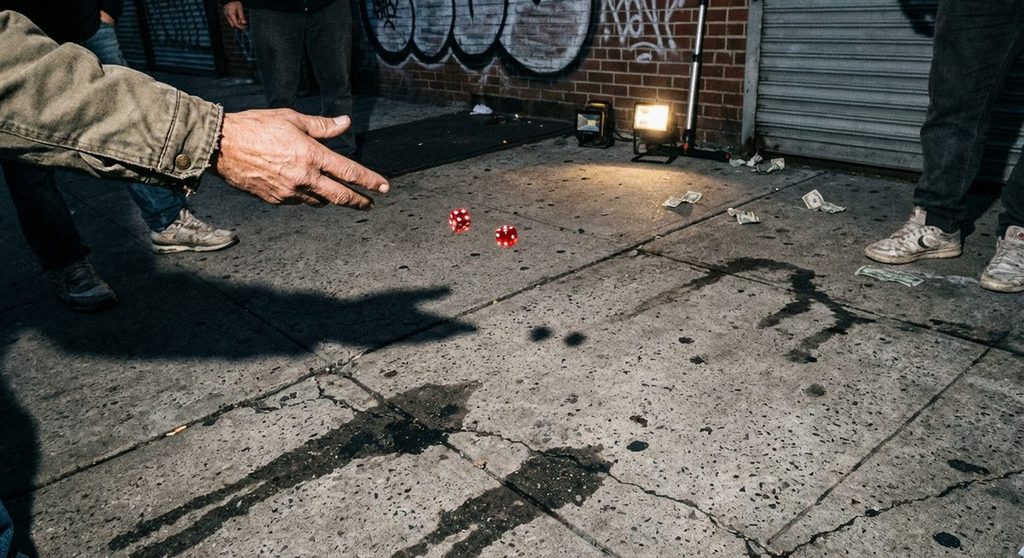
Street craps is the raw, unfiltered version of the dice game that millions know from glitzy casino floors. Stripped of the felt table, the stickman, and the flashing lights, street craps — also called shooting dice or street dice — is played on any flat surface with nothing more than a pair of dice, cash, and willing participants.
Unlike casino craps, there is no house edge in street craps. Every bet is player versus player, making it one of the purest forms of gambling that exists. The shooter puts money down, other players cover (or “fade”) the bet, and the dice decide who walks away richer.
Street craps predates the modern casino game by decades. In many ways, it is the original form of craps — the version that gave birth to the elaborate table game we see in casinos today. Understanding street craps means understanding the roots of one of the world’s most popular gambling games.
History of Street Craps
The history of street craps is deeply intertwined with the broader history of craps itself, but it follows its own distinct cultural path.
19th Century Origins
Whilst casino craps evolved from the European game of Hazard — brought to New Orleans by French settlers in the early 1800s — street craps developed as a parallel tradition. As the formal game moved into gambling halls and riverboat casinos, a simpler version thrived in alleyways, street corners, and back rooms across America.
By the mid-1800s, street dice games were a fixture in working-class neighbourhoods, particularly within African American communities in the American South. The game required no equipment beyond dice and offered excitement and the possibility of quick money to people who had no access to — or interest in — formal gambling establishments.
Military Barracks and Global Spread
Street craps exploded in popularity during the First and Second World Wars. Soldiers stationed in cramped barracks with limited entertainment turned to dice as a way to pass time and gamble their wages. The game spread rapidly through military camps, crossing racial, ethnic, and class barriers.
Veterans returning home after the wars brought street craps back to their communities, cementing it as a widespread cultural phenomenon. By the 1950s, shooting dice was a recognised pastime across urban America and had begun appearing in British cities as well, carried by American servicemen stationed at bases throughout the United Kingdom.
Urban Culture and Hip-Hop
From the 1980s onwards, street craps became heavily associated with urban culture and hip-hop. Films like Do the Right Thing, Friday, and Paid in Full featured iconic dice-shooting scenes. Rappers from Biggie to Jay-Z referenced the game in their lyrics, turning it into a symbol of street life, risk-taking, and hustle.
This cultural connection gave street craps a visibility that few informal gambling games have ever achieved. Today, millions of people worldwide know how to shoot dice — even if they have never set foot inside a casino.
How to Play Street Craps — Complete Rules
If you already understand how to play craps in a casino setting, street craps will feel familiar. The core mechanics are the same, but the structure is looser and the betting is handled directly between players.
Step 1: Setting Up
Street craps requires minimal equipment:
- Two standard six-sided dice — ideally transparent to prevent tampering
- A flat surface — pavement, a table, a floor, or any area where dice can be thrown against a wall or kerb
- Cash — all bets are placed in physical money, visible to all players
- A wall or backstop — most games require the shooter to bounce dice off a wall to ensure a fair roll
There is no minimum or maximum number of players, though most games involve between three and ten participants. Players typically stand or kneel in a circle or semicircle around the throwing area.
Step 2: The Shooter and the Fade
One player volunteers or is selected to be the shooter. The shooter places a bet — this can be any agreed amount — in the centre of the playing area. This initial wager is the shooter’s stake.
Other players must then fade the bet, meaning they collectively put up enough money to match the shooter’s wager. For example, if the shooter puts down £50, other players must contribute a combined £50 to cover the bet.
If the full amount is not faded, the shooter must reduce their bet to the amount that has been covered. This ensures every pound wagered has an equal and opposite stake.
Step 3: Establishing Side Bets
Before the dice are thrown, players may also place side bets with one another. These are independent wagers between individual players on the outcome of the roll. Common side bets include:
- Betting on the shooter to win or lose
- Betting on specific numbers being rolled
- Proposition bets on the next roll’s outcome
Side bets have no fixed structure — they are negotiated between the players involved. This is one of the key differences from casino craps, where all bet types are predefined with specific payouts.
Step 4: The Come Out Roll
Once all bets are placed, the shooter throws the dice. This first throw is the come out roll, and the outcomes mirror those in casino craps:
- Natural (7 or 11): The shooter wins immediately. They collect the faded money plus their original bet.
- Craps (2, 3, or 12): The shooter loses immediately. The faders split the pot according to their contributions.
- Any other number (4, 5, 6, 8, 9, or 10): That number becomes the point.
Step 5: The Point Phase
If a point is established, the shooter continues rolling. During this phase, only two outcomes matter:
- Rolling the point number again: The shooter wins and collects the pot.
- Rolling a 7 (known as “sevening out”): The shooter loses and the faders collect.
All other numbers rolled during the point phase are irrelevant to the main bet, though they may affect side bets between players. The shooter keeps rolling until they either hit their point or seven out.
Step 6: Resolution
When the round ends, money changes hands. If the shooter won, they collect the entire pot. If they lost, the faders divide the money proportionally based on how much each contributed to the fade.
The dice then pass to the next player who wishes to shoot, and the process begins again. There is no obligation to shoot — players may choose to be faders only for the entire game.
Example Round
Scenario: Four players — Alex (shooter), Ben, Claire, and Dave.
- Alex puts £40 in the centre as his bet.
- Ben fades £20, Claire fades £15, and Dave fades £5. The total fade is £40, matching Alex’s bet.
- Alex rolls a 9 — this becomes the point.
- Meanwhile, Ben and Claire make a £10 side bet: Ben bets Alex will make his point, Claire bets he won’t.
- Alex rolls: 5, then 11, then 3, then 9. He hits his point!
- Alex collects the £80 pot (his £40 plus the £40 fade). Ben collects £10 from Claire on their side bet.
Street Craps Betting System
The betting system in street craps is fundamentally different from casino craps because there is no house. Every bet is a direct wager between players, and the mathematical odds are pure.
The Fade
The fade is the core bet. The shooter bets they will win (roll a natural on the come out, or make their point). The faders bet the shooter will lose. The probability breakdown is straightforward:
- The shooter has approximately a 49.29% chance of winning any given round
- The faders have approximately a 50.71% chance of winning
This slim mathematical edge for the faders exists because of the slight imbalance between naturals and craps numbers. However, with no house taking a cut, both sides face essentially even odds — far better than any casino bet.
Side Bets
Side bets in street craps are limited only by what the players agree upon. Common side bets include:
- “He hits” / “He don’t” — Betting for or against the shooter during the point phase
- Number bets — Betting a specific number will appear before a 7
- One-roll bets — Betting on the outcome of the very next throw
- Hardway bets — Betting a number will be rolled as a double (e.g., 4 as 2+2) before it appears any other way or a 7 is rolled
No House Edge
This is the single most important distinction between street craps and casino craps. In a casino, the house takes a percentage of every bet through built-in mathematical advantages. The pass line bet carries a 1.41% house edge, and most other bets are significantly worse.
In street craps, there is zero house edge. Every pound one player loses goes directly to another player. Over the long run, the mathematics of the dice determine outcomes, but no third party is skimming profits off the top.
This makes street craps, from a purely mathematical standpoint, one of the fairest gambling games in existence — provided, of course, that the dice are fair.
Street Craps vs Casino Craps — Key Differences
Whilst the fundamental dice mechanics are identical, street craps and casino craps differ in almost every other respect. Here is a comprehensive comparison:
| Aspect | Street Craps | Casino Craps |
|---|---|---|
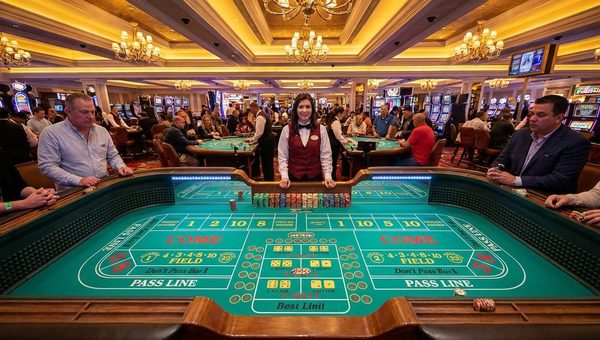
| Playing Surface | Any flat surface — pavement, floor, table | Purpose-built felt table with printed layout |
| Staff | None — players manage the game | Boxman, stickman, two dealers |
| House Edge | None — player vs player | 1.41% on pass line; higher on other bets |
| Bet Types | Fade + informal side bets | 30+ structured bet types |
| Odds Bet | Not applicable (all bets are effectively at true odds) | Available — the only zero-edge bet in the casino |
| Etiquette | Informal, varies by group | Strict rules about dice handling, chip placement |
| Legality | Often illegal in public spaces | Fully legal in licensed establishments |
| Pace | Fast — no chip counting or dealer procedures | Moderate — structured rounds with dealer involvement |
| Dice Integrity | Risk of loaded or tampered dice | Casino-grade precision dice, regularly replaced |
For a full breakdown of how the odds work in both versions, visit our craps odds and payouts guide.
Street Craps Terminology
Street craps has its own rich vocabulary that blends traditional gambling terms with street slang. Here are the essential terms every player should know:
- Shooter — The player rolling the dice
- Fade — To cover the shooter’s bet; also the act of matching the wager
- Come out roll — The first roll of a new round
- Point — The number established on the come out roll (4, 5, 6, 8, 9, or 10)
- Natural — Rolling a 7 or 11 on the come out roll (instant win for the shooter)
- Craps — Rolling 2, 3, or 12 on the come out roll (instant loss for the shooter)
- Snake eyes — Rolling a 2 (two ones)
- Boxcars — Rolling a 12 (two sixes)
- Seven out — Rolling a 7 during the point phase (shooter loses)
- Bones — Slang for dice
- Cee-lo — A related street dice game often played alongside craps
- Bank — The total money in play for a round
- Side action — Any bet not part of the main fade
- Wall — The surface dice must be thrown against to ensure a fair roll
- Brick — A die that barely rolls or does not hit the wall
Regional Slang Variations
Terminology varies significantly by region. In some American cities, the fade is called “covering” or “banking.” In parts of London, shooting dice is sometimes referred to as “rolling bones.” The come out roll might simply be called “the first throw” in more casual British games.
These linguistic variations are part of the game’s charm — they reflect the local culture and history of each community where street craps is played.
Is Street Craps Legal in the UK?
The legality of street craps in the United Kingdom is nuanced, governed primarily by the Gambling Act 2005.
Private Gambling
Under the Gambling Act, private gambling is generally legal in the UK. If you and your mates are playing craps in someone’s home, garden, or private property, this falls under the “private gaming” exemption. The key conditions are:
- No charge is made for participation beyond the stakes wagered
- No one is running the game as a business or taking a cut
- The game takes place in a private setting
As long as these conditions are met, a private game of street craps between friends is perfectly legal.
Public Gambling
Playing street craps in a public place — such as a street, park, alleyway, or car park — is a different matter entirely. Gambling in public spaces without a licence is generally prohibited. Local authorities and police have the power to break up unlicensed gambling and may issue fines or other penalties.
The Gambling Act distinguishes between casual private gaming and organised gambling. If a street craps game in a public place is seen as organised or regular, it is more likely to attract enforcement action.
Key Legal Considerations
- No house or organiser may take a cut — if someone is running the game for profit, it becomes unlicensed commercial gambling
- Age restrictions apply — all participants must be 18 or over
- Anti-social behaviour — even if the gambling itself is tolerated, noise, crowding, or intimidation in public spaces can lead to police intervention under anti-social behaviour legislation
In practical terms, a quiet game of dice among adults in a private setting is unlikely to cause legal issues. Playing on a street corner in central London is another matter.
Tips for Playing Street Craps
Whether you are a complete beginner or transitioning from casino craps, these tips will help you navigate street dice games more effectively.
1. Manage Your Bankroll Strictly
Without the structure of a casino, it is easy to lose track of spending in a street game. Set a firm budget before you start and stick to it. Never chase losses, and never bet money you cannot afford to lose.
A good rule of thumb: bring only what you are prepared to walk away without. Leave your bank card at home.
2. Understand the True Odds
Because there is no house edge, the true mathematical odds are what determine long-term outcomes. The probability of rolling each number is fixed:
- 7 can be made six ways (most common roll)
- 6 and 8 can each be made five ways
- 5 and 9 can each be made four ways
- 4 and 10 can each be made three ways
- 3 and 11 can each be made two ways
- 2 and 12 can each be made one way
Understanding these probabilities allows you to evaluate side bets intelligently. If someone offers you even money that a 4 will be rolled before a 7, the true odds are 2:1 against — a terrible bet.
3. Watch Out for Loaded Dice
Loaded or weighted dice are the oldest scam in gambling. In a casino, precision-manufactured dice are regularly inspected and replaced. In a street game, there is no such oversight.
Signs of potentially loaded dice include:
- A player insisting on using their own dice
- Dice that consistently produce unusual distributions of numbers
- Dice that feel heavier on one side when held lightly
- Non-transparent dice (transparent dice are harder to tamper with)
Always insist on transparent dice and rotate dice periodically if suspicion arises.
4. Choose the Fade Side When Possible
As we covered earlier, faders have a slight mathematical edge (50.71% vs 49.29%). Over many rounds, consistently fading rather than shooting gives you a marginal advantage. It is not dramatic, but in a game with no house edge, even small edges compound.
5. Know When to Leave
Street craps has no closing time. Games can run for hours, and the social pressure to keep playing can be intense. Set a win target as well as a loss limit. If you double your money, consider pocketing half and playing with the rest.
The best gambling advice — for street craps or any game — remains the same: quit whilst you are ahead.
Frequently Asked Questions About Street Craps
What do you need to play street craps?
You need just two standard six-sided dice, cash for wagering, and a flat surface to throw on. Most games also use a wall or kerb as a backstop to ensure fair rolls. Transparent dice are recommended to prevent cheating.
How is street craps different from casino craps?
The biggest difference is the absence of a house edge. In street craps, all bets are between players — no casino takes a percentage. There is also no table layout, no dealers, and far fewer structured bet types. The basic dice mechanics (come out roll, point, seven out) remain the same.
Is street craps rigged?
The game itself is not rigged — the mathematics of two fair dice are immutable. However, individual games can be compromised through loaded dice, sleight of hand, or other cheating methods. Using transparent dice and insisting on a wall bounce helps mitigate these risks.
Can you play street craps legally in the UK?
Private games among friends in a private setting are legal under the Gambling Act 2005, provided no one takes a cut and all players are over 18. Playing in public spaces is generally prohibited and may result in fines or police intervention.
What does “fade” mean in street craps?
To fade means to cover the shooter’s bet. When the shooter places their wager, other players must collectively match that amount. If the shooter bets £50, faders must put up a combined £50. The term comes from the idea of “fading” or matching the bet.
What is a natural in street craps?
A natural is when the shooter rolls a 7 or 11 on the come out roll (the first roll of a new round). This is an instant win for the shooter. The term is also used in casino craps and comes from the idea that these are the “natural” winning numbers.
What are the odds of winning as the shooter?
The shooter has approximately a 49.29% chance of winning any given round, whilst the faders collectively have a 50.71% chance. This slight imbalance exists because craps numbers (2, 3, 12) outweigh naturals (7, 11) on the come out roll by a small margin.
How do side bets work in street craps?
Side bets are informal wagers between individual players, separate from the main fade. Players might bet on whether the shooter will make their point, whether a specific number will appear, or on the outcome of the very next roll. Terms and payouts are negotiated directly between the bettors.
Can you play street craps online?
Traditional street craps is inherently an in-person game. However, many online casinos offer craps games that follow the same basic rules. Whilst they add a house edge through structured betting, they provide a convenient way to practise the fundamentals before playing a real street game.
What happens if the shooter’s bet is not fully faded?
If other players do not put up enough money to match the shooter’s bet, the shooter must reduce their wager to the amount that has been covered. For instance, if the shooter bets £100 but only £60 is faded, the shooter takes back £40 and plays for £60.
Why do players throw dice against a wall?
Throwing dice against a wall or backstop ensures a more random result. Without a wall, a skilled thrower could potentially control the dice through techniques like dice sliding or controlled setting. The wall bounce adds an unpredictable element that makes cheating significantly harder.
What is the best strategy for street craps?
Since there is no house edge, no strategy can give you a mathematical advantage over fair dice. The best approach is strict bankroll management, understanding the true odds of each number, fading rather than shooting when possible (for the slight mathematical edge), and always using transparent dice to ensure fairness.
How long does a typical street craps game last?
A single round can last anywhere from one roll (if a natural or craps is thrown on the come out) to dozens of rolls during an extended point phase. Full sessions between groups of players often last several hours, as the dice rotate between shooters and new rounds begin continuously.
What is the difference between street craps and cee-lo?
Cee-lo (also spelled C-Lo or 4-5-6) is a different street dice game that uses three dice instead of two. Players take turns rolling, and specific combinations (like 4-5-6) determine wins or losses. Whilst both games are played informally on the street, they have entirely different rules and scoring systems.