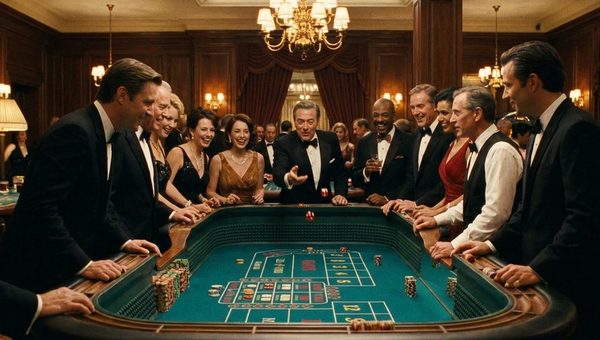


Understanding the Core Rules of Craps
Craps may appear complex at first glance, but the core rules are straightforward once you break them down. The game revolves around the roll of two dice, with players betting on the outcomes. Every rule in craps ties back to one central concept: will the shooter make their point, or will they seven-out?
This guide covers every rule you need to understand before playing craps — whether at a UK casino or online. We explain the come out roll, point phase, bet resolution, shooter rotation, and all the nuances that separate confident players from confused ones.
The Fundamental Flow: Come Out Roll and Point Phase
Every craps round follows a two-phase structure. Understanding these phases is essential because different rules apply during each one.
Phase 1: The Come Out Roll
The come out roll is the opening roll of a new craps round. Before rolling, the shooter and other players at the table place their initial bets — most commonly on the Pass Line or Don’t Pass Bar.
The come out roll has three possible outcomes:
- Natural (7 or 11): Pass Line wins, Don’t Pass loses. The round ends and a new come out roll begins with the same shooter.
- Craps (2, 3, or 12): Pass Line loses. Don’t Pass wins on 2 and 3. On 12, Don’t Pass is a push (tie) in most casinos. The round ends and the same shooter rolls again.
- Point established (4, 5, 6, 8, 9, or 10): The dealer places the ON puck on the rolled number. The game moves to Phase 2.
Phase 2: The Point Phase
Once a point is set, the rules shift. The shooter continues rolling with one objective in mind:
- Roll the point number again → Pass Line wins, Don’t Pass loses.
- Roll a 7 (seven-out) → Pass Line loses, Don’t Pass wins. The dice pass to the next shooter.
- Roll any other number → The round continues. Other bets may resolve (Come, Place, Field, etc.) but the Pass/Don’t Pass remains active.
Shooter Rules and Rotation
The shooter is the player who physically throws the dice. In both live and some online formats, specific rules govern who shoots and how.
Becoming the Shooter
- The dice move clockwise around the table.
- When it is your turn, you may accept or decline. If you decline, the dice pass to the next player.
- The shooter must place a bet on either the Pass Line or Don’t Pass Bar before rolling.
- You remain the shooter as long as you keep making points or rolling naturals/craps on come out rolls. You only lose the dice when you seven-out during the point phase.
Dice Throwing Rules
In land-based casinos, the following rules apply to the physical dice throw:
- You must throw both dice with one hand.
- The dice must hit the far wall of the table (the back wall with the pyramid-patterned rubber).
- The dice must not leave the table. If they do, the stickman will offer replacement dice.
- You should not blow on the dice or perform excessive rituals that delay the game.
- Only one hand may touch the dice — switching hands or using two hands is not permitted.
For more on proper behaviour at the table, see our craps etiquette guide.
Bet Resolution Rules
Different bets resolve at different times during a craps round. Understanding when each bet wins, loses, or remains active is crucial.
Pass Line Rules
- Wins: Come out roll of 7 or 11; point number rolled before 7.
- Loses: Come out roll of 2, 3, or 12; 7 rolled before point number.
- Important: Once placed, a Pass Line bet cannot be removed or reduced during the point phase. This is a contract bet.
Don’t Pass Rules
- Wins: Come out roll of 2 or 3; 7 rolled before point number.
- Pushes: Come out roll of 12 (in most casinos; some use 2 as the push number instead).
- Loses: Come out roll of 7 or 11; point number rolled before 7.
- Important: Unlike Pass Line, Don’t Pass bets can be removed during the point phase (though mathematically you should never do this, as the edge shifts in your favour once a point is established).
Come and Don’t Come Rules
Come and Don’t Come bets follow the same rules as Pass and Don’t Pass, but they can be placed at any time during the point phase. Each Come bet effectively creates its own mini come out roll:
- The next roll after placing a Come bet acts as that bet’s come out roll.
- If 7 or 11 is rolled, the Come bet wins (but your Pass Line bet loses to the 7).
- If 2, 3, or 12 is rolled, the Come bet loses.
- Any other number establishes a point for that specific Come bet.
Place Bet Rules
- You can place bets on 4, 5, 6, 8, 9, or 10 at any time during the point phase.
- The bet wins if your chosen number is rolled before a 7.
- Place bets can be turned on, off, increased, decreased, or removed at any time.
- They are automatically off during the come out roll (unless you specify otherwise).
- Payouts: 6 and 8 pay 7:6, 5 and 9 pay 7:5, 4 and 10 pay 9:5.
Field Bet Rules
- The Field is a single-roll bet resolved on the very next roll.
- Wins on 2, 3, 4, 9, 10, 11, or 12.
- Loses on 5, 6, 7, or 8.
- Typically pays even money on most numbers, double on 2, and double or triple on 12.
Odds Bet Rules
- Available only after a point is established on Pass Line, Don’t Pass, Come, or Don’t Come bets.
- Pays at true mathematical odds — no house edge.
- Maximum Odds vary by casino: common limits are 3-4-5x, 5x, 10x, or 100x.
- Can be added, removed, or adjusted at any time during the point phase.
- Pass Line Odds are placed directly behind the original bet; Come bet Odds are given to the dealer to place.
Proposition Bet Rules
Proposition bets (prop bets) are placed in the centre of the table and managed by the stickman. Most are single-roll bets with high house edges.
Single-Roll Proposition Bets
- Any Seven: Wins if the next roll is 7. Pays 4:1. House edge: 16.67%.
- Any Craps: Wins on 2, 3, or 12. Pays 7:1. House edge: 11.11%.
- Ace Deuce (3): Wins on 3 only. Pays 15:1. House edge: 11.11%.
- Aces (2): Wins on 2 only. Pays 30:1. House edge: 13.89%.
- Boxcars (12): Wins on 12 only. Pays 30:1. House edge: 13.89%.
- Yo (11): Wins on 11 only. Pays 15:1. House edge: 11.11%.
- Horn Bet: Combination bet on 2, 3, 11, and 12. House edge: 12.5%.
Multi-Roll Proposition Bets (Hardways)
- Hard 4 (2+2): Wins before easy 4 or 7. Pays 7:1. House edge: 11.11%.
- Hard 6 (3+3): Wins before easy 6 or 7. Pays 9:1. House edge: 9.09%.
- Hard 8 (4+4): Wins before easy 8 or 7. Pays 9:1. House edge: 9.09%.
- Hard 10 (5+5): Wins before easy 10 or 7. Pays 7:1. House edge: 11.11%.
Special Rules and Edge Cases
The Bar 12 Rule
On the Don’t Pass and Don’t Come areas, you will see “Bar 12” (or occasionally “Bar 2”). This means that if 12 (or 2) is rolled on the come out, Don’t Pass bettors neither win nor lose — it is a push. This rule exists to give the house an edge on Don’t Pass bets; without it, Don’t bettors would have a mathematical advantage.
Working and Not Working
During the come out roll, certain bets are automatically turned off (“not working”). Place bets and Odds on Come bets are typically off during the come out unless the player specifically asks to have them “working.” The Pass Line and Don’t Pass are always working.
Buying and Laying Bets
- Buy bets: Similar to Place bets but pay at true odds in exchange for a 5% commission (vig). Mathematically better for 4 and 10.
- Lay bets: The opposite of Buy bets — you are betting that 7 will be rolled before a specific number. Also requires a 5% commission on the potential win.
Maximum and Minimum Bet Rules
Every craps table displays minimum and maximum bet limits. In the UK:
- Land-based: Minimum bets typically range from £5 to £25. Maximums can reach £10,000 or more at high-roller tables.
- Online: Minimums can be as low as £0.10 with maximums around £500 to £5,000 depending on the operator.
Rules Differences Between Online and Live Craps
The fundamental rules of craps remain identical whether you play online or in a land-based casino. However, there are practical differences:
- Dice throwing: Online, a random number generator (RNG) determines outcomes. No physical dice are used except in live dealer games.
- Bet placement: Online, you click betting areas directly. In live craps, some bets (Place, Come Odds) must be placed by the dealer.
- Odds limits: Online casinos may offer different Odds limits than land-based venues.
- Pace: Online craps is typically faster since there is no need to wait for physical dice throws and bet collections.
- Shooter role: In standard online craps, you are always the shooter. In live dealer craps, the dealer or a designated player shoots.
For a complete beginner’s walkthrough, see our how to play craps guide.
Frequently Asked Questions About Craps Rules
Can I remove my Pass Line bet after a point is established?
No. The Pass Line bet is a contract bet — once the point is set, you cannot remove or reduce it. This is because the mathematical edge shifts in the casino’s favour once a point is established. Don’t Pass bets, however, can be removed at any time (though doing so is mathematically disadvantageous for the player).
What happens if the dice go off the table?
If one or both dice leave the table during a roll, the stickman will offer the shooter a fresh set of five dice to choose from. Most casinos will also inspect the dice that left the table. The roll does not count and the shooter rolls again. Some superstitious players request “same dice” — meaning they want the same dice returned.
Is there a maximum number of rolls per round?
No. A craps round continues until the point is made or the shooter sevens out. Theoretically, a round could last hundreds of rolls, though this is exceptionally rare. The longest recorded craps roll lasted over four hours with 154 consecutive rolls.
What is the difference between a seven-out and rolling a 7 on the come out?
Rolling a 7 on the come out is a natural — Pass Line bets win and a new come out roll begins. A seven-out occurs only during the point phase, when a 7 is rolled before the point number. This ends the round, Pass Line bets lose, and the dice pass to the next shooter. These are completely different outcomes despite both involving the number 7.
Do craps rules differ between UK and US casinos?
The fundamental rules are identical worldwide. Minor differences may include table minimums, maximum Odds offered, and whether certain proposition bets are available. UK online casinos regulated by the UKGC follow the same game rules as their land-based counterparts.
Can I bet on both Pass Line and Don’t Pass at the same time?
Technically yes, but it is not advisable. You would effectively be betting against yourself. On the come out roll, a 7 wins Pass but loses Don’t Pass, whilst 2 or 3 loses Pass but wins Don’t Pass. The only non-cancelling outcome is 12 (Pass loses, Don’t Pass pushes), meaning you would slowly lose money to the bar number. This strategy has no practical value.
What are the rules for tipping dealers in UK craps?
In UK casinos, tipping practices differ from the US. Many UK casino staff are paid a salary and tipping is less expected. However, you can tip by placing a bet for the dealers (often on the Pass Line) or by giving chips directly. Online, tipping does not apply.
Are Place bets working during the come out roll?
By default, Place bets are off (not working) during the come out roll. However, you can ask the dealer to keep them “working” if you wish. Come bet Odds are also typically off during the come out unless specified. This default protects players from losing Place bets to a come out 7.
What happens to my Come bet if the shooter sevens out?
If you have an active Come bet on a number and the shooter rolls a 7, your Come bet loses (since 7 came before your Come point). However, any new Come bet placed on that same roll wins because a 7 on the come out is a natural for Come bets. This dual outcome often confuses beginners.
Can the casino change the rules mid-game?
No. Once a round is in progress, the rules cannot change. Casinos may adjust table limits or Odds limits between sessions, but active bets are always resolved under the rules in effect when they were placed. Online casinos regulated by the UKGC must clearly display all rules before play begins.
What is a contract bet in craps?
A contract bet is a wager that cannot be removed once the point phase begins. The Pass Line and Come bets are contract bets. The Don’t Pass, Don’t Come, Place bets, and Odds bets are not — they can be removed or reduced at any time during the point phase.
Is there a rule about which hand to use when throwing dice?
Yes. In most land-based casinos, you must use only one hand to pick up and throw the dice. Switching the dice between hands is not allowed. The casino does not specify which hand you must use — left or right is fine — but using two hands simultaneously is prohibited to prevent dice switching.