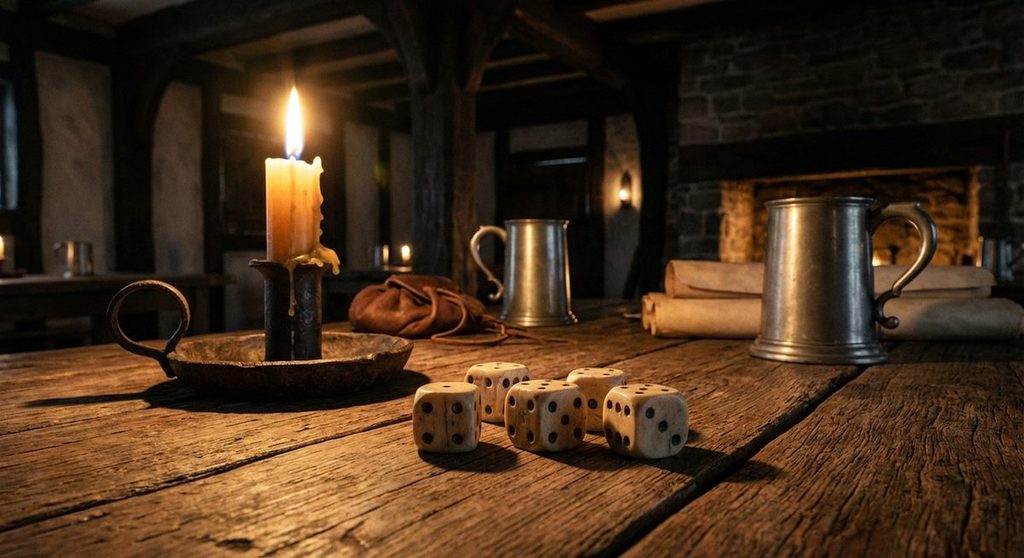

Long before the neon lights of Las Vegas or the polished digital interfaces of online casinos, dice games ruled the taverns and courts of medieval Europe. Among them, one game stood above all others: Hazard. This complex, thrilling dice game captivated English gamblers for centuries — and ultimately evolved into the game we know today as craps. Understanding Hazard is essential for any serious craps enthusiast, because the DNA of this medieval pastime runs through every roll of the dice at a modern craps table.
Origins of Hazard — From the Crusades to English Taverns
The precise origins of Hazard remain shrouded in the mists of history, though several compelling theories exist. The most romantic account credits Sir William of Tyre, a 12th-century chronicler, with documenting the game during the Crusades. According to this tradition, Crusaders played Hazard at a castle called Hazarth (or Asart) in modern-day Israel during the siege of 1125. However, modern historians treat this etymology with scepticism — the word more likely derives from the Arabic al-zahr, meaning “the die.”
What is certain is that by the 14th century, Hazard had become deeply embedded in English culture. The game thrived in taverns, alehouses, and noble courts alike. It was a great social equaliser — lords and labourers could be found hunched over the same table, wagering on the same rolls.
Geoffrey Chaucer immortalised the game in The Canterbury Tales (c. 1390). In The Pardoner’s Tale, Chaucer describes dissolute young men who waste their lives on “hasardrye” — gambling at Hazard. The Pardoner condemns it as a gateway to all manner of sin:
“Hasard is verray mooder of lesynges, / And of deceite, and cursed forswerynges.” (Hazard is truly the mother of lies, and of deceit, and cursed perjuries.)
By the 17th century, Hazard had reached its golden age. Samuel Pepys, the famous diarist, recorded losing money at Hazard on multiple occasions during the 1660s. The game was so prevalent in Restoration England that it became a fixture of the newly emerging gambling houses.
How to Play Hazard — Complete Rules Explained
Hazard is considerably more complex than modern craps, which partly explains why it was eventually simplified. Here is a thorough breakdown of the rules, using the terminology that would have been familiar to a 17th-century gambler.
The Key Roles
The Caster is the player who throws the dice — equivalent to the shooter in craps. Other players, known as setters, bet against the caster. The caster retains the dice as long as they keep winning.
Phase 1: Calling a Main
Before rolling, the caster must call a Main — a number between 5 and 9 (inclusive). This is the target number. In modern craps, the equivalent would be a fixed point of 7, but in Hazard the caster chooses their own main, adding a layer of strategy absent from the modern game.
Phase 2: The First Throw — Nicks and Outs
The caster throws two dice. Depending on the main called and the number thrown, the result is either:
- Nick — an instant win for the caster
- Out — an instant loss for the caster (setters win)
- Chance — a point is established (play continues)
The nick and out combinations depend entirely on the main called. Here is the complete table:
| Main Called | Nicks (Caster Wins Instantly) | Outs (Caster Loses Instantly) |
|---|---|---|
| 5 | 5 | 2, 3, 11, 12 |
| 6 | 6, 12 | 2, 3, 11 |
| 7 | 7, 11 | 2, 3, 12 |
| 8 | 8, 12 | 2, 3, 11 |
| 9 | 9 | 2, 3, 11, 12 |
Notice how calling 7 as your main gives you the same instant-win conditions as the modern craps come-out roll (7 or 11 wins, 2, 3, or 12 loses). This is no coincidence — it is the direct ancestor of the pass line bet.
Phase 3: The Chance
If the first throw produces neither a nick nor an out, the number thrown becomes the Chance — functionally identical to establishing a point in modern craps. The caster continues rolling:
- If the Chance is thrown again before the Main, the caster wins
- If the Main is thrown before the Chance, the caster loses
This is the reverse of what many beginners expect — in the chance phase, hitting your main is bad. The caster wants to repeat their chance number. Compare this to modern craps, where the shooter wants to hit their point before rolling a 7.
Hazard vs Modern Craps — Key Differences
Understanding how Hazard differs from craps illuminates why the newer game became dominant. Here is a detailed comparison:
| Feature | Hazard | Modern Craps |
|---|---|---|
| Main/Point | Caster chooses from 5–9 | Fixed at 7 on come-out |
| Instant Win | Varies by main called | 7 or 11 on come-out |
| Instant Loss | Varies by main called | 2, 3, or 12 on come-out |
| Point Phase | Roll chance before main | Roll point before 7 |
| Number of Bet Types | Essentially one (caster vs setters) | Dozens of side bets |
| House Involvement | None — player vs player | Casino banks all bets |
| Complexity | High — variable outcomes per main | Lower — standardised rules |
| Speed of Play | Slower — negotiation between players | Faster — fixed procedures |
Why Hazard Was More Complex
The variable main system meant that players needed to memorise different nick and out combinations for each of five possible mains. Skilled Hazard players would choose their main strategically, calculating which number gave them the best chance of winning given the current odds and their personal superstitions.
Modern craps stripped away this complexity by fixing the come-out number at 7, standardising the instant win/loss conditions, and adding a vast array of side bets to compensate for the simpler core mechanic. The result was a faster, more accessible game that could be banked by a casino rather than played purely between individuals.
Hazard in Literature and Culture
Few dice games have left such a deep imprint on English-language culture as Hazard. The game appears repeatedly across centuries of literature, reflecting its central role in British social life.
Chaucer and Medieval Morality
As noted above, Chaucer used Hazard in The Canterbury Tales as a symbol of moral decay. The Pardoner — himself an ironic figure of corruption — condemns gambling alongside drunkenness and gluttony. For medieval audiences, Hazard represented the temptation of easy wealth and the ruin it inevitably brought.
Shakespeare and the Elizabethan Era
William Shakespeare referenced the game in Henry V (c. 1599), where the king speaks of lives at stake: “The man that once did sell the lion’s skin / While the beast lived, was killed with hunting him.” The language of Hazard — particularly the word “hazard” itself, meaning risk or danger — had by Shakespeare’s time become embedded in everyday English. We still use it today whenever we say something is “hazardous.”
The Georgian Gambling Houses
The 18th century saw Hazard reach its most glamorous heights. London’s exclusive gambling clubs, particularly Crockford’s Club on St James’s Street, became legendary venues for high-stakes Hazard. Founded by William Crockford in 1828, the club attracted dukes, earls, and members of Parliament who would wager enormous sums on a single evening’s play.
Crockford’s was notoriously ruthless. The house reportedly made over one million pounds in its first two years — a staggering fortune in Regency-era money. Many aristocrats were ruined at its tables. The Duke of Wellington himself was known to frequent the establishment, though he reportedly played with more caution than many of his peers.
The Transition from Hazard to Craps
The transformation of Hazard into craps is one of gambling history’s most fascinating stories, spanning continents and centuries.
The French Connection
Hazard crossed the English Channel to France, where it gained popularity among the French aristocracy in the 17th and 18th centuries. French players adopted the game with modifications, and crucially, they gave a specific name to the losing throw of two (known as “crabs” in English Hazard slang). The French pronunciation of “crabs” — crabes or craps — would eventually give the new game its name.
Bernard de Marigny and New Orleans
The pivotal figure in the transition was Bernard Xavier Philippe de Marigny de Mandeville, a wealthy young Creole nobleman from New Orleans. In the early 19th century, Marigny brought a simplified version of Hazard back from his travels in Europe to the streets and gambling dens of Louisiana.
Marigny’s version stripped away the variable main system, fixing the game around the number 7. The complex nick and out tables were replaced by the straightforward rules we recognise today: 7 or 11 wins on the come-out, 2, 3, or 12 loses, and any other number establishes a point. This simplification made the game accessible to the diverse, multilingual population of New Orleans — French Creoles, African Americans, Anglo-Americans, and immigrants from across the world.
The game spread rapidly along the Mississippi River via steamboat gambling, and by the mid-19th century, “craps” had become one of America’s most popular dice games. When John H. Winn introduced the “Don’t Pass” bet in the early 20th century, the modern casino version of craps was essentially complete.
The “Crabs” to “Craps” Etymology
The most widely accepted etymology traces the word through these steps:
- In English Hazard, rolling a 2 was called “crabs” — the worst possible throw
- French players adopted the term, pronouncing it “crabes”
- In Louisiana French Creole, this became “craps”
- The name transferred from the specific losing throw to the entire game
Can You Still Play Hazard Today?
Whilst Hazard is no longer offered in commercial casinos, the game has not entirely vanished. Historical gaming societies and medieval re-enactment groups occasionally play Hazard using period-accurate rules. Some online platforms have created digital versions, though these are rare compared to the thousands of sites offering modern craps.
For those interested in experiencing something close to Hazard’s spirit, the best approach is to gather friends, two standard dice, and the rules outlined above. The game works brilliantly as a social activity — the caster’s ability to choose their main creates lively debate and tactical discussion that you simply do not get with modern craps.
Understanding Hazard also deepens your appreciation of craps strategy. When you know that the pass line bet is essentially a streamlined version of calling 7 as your main in Hazard, the logic behind the game’s structure becomes beautifully clear.
Frequently Asked Questions About Hazard
What is the Hazard dice game?
Hazard is a medieval English dice game played with two dice, where a player (the caster) chooses a target number called the “main” (between 5 and 9) and rolls to achieve specific outcomes. It is the direct historical ancestor of modern craps and was one of the most popular gambling games in England from the 14th to the 19th century.
Who invented Hazard?
The exact inventor is unknown. A popular legend credits Crusaders at the castle of Hazarth in the 12th century, with Sir William of Tyre sometimes mentioned. However, most historians believe the game evolved gradually, with its name likely derived from the Arabic word al-zahr meaning “the die.” No single inventor can be reliably identified.
How did Hazard become craps?
Hazard crossed from England to France, where the losing roll of 2 (called “crabs”) was adapted into the French pronunciation “craps.” In the early 1800s, Bernard de Marigny brought a simplified version from France to New Orleans. The variable main system was replaced with a fixed structure centred on 7, creating the streamlined game we know as craps today.
What does “calling a main” mean in Hazard?
Calling a main is the first action in Hazard. The caster announces a number between 5 and 9 before rolling. This number determines which outcomes are instant wins (nicks), instant losses (outs), or establish a chance (point). In modern craps, this choice was eliminated — the equivalent “main” is always 7.
What are nicks and outs in Hazard?
Nicks are instant wins for the caster, and outs are instant losses. The specific numbers that count as nicks or outs change depending on which main the caster has called. For example, with a main of 7, rolling 7 or 11 is a nick (win) whilst rolling 2, 3, or 12 is an out (loss) — identical to the modern craps come-out roll.
Is Hazard harder to learn than craps?
Yes, significantly. Hazard requires memorising different nick and out combinations for five possible mains (5 through 9), whereas craps has a single standardised set of come-out rules. The chance phase in Hazard also works differently depending on the main, adding further complexity. This difficulty was a key reason Hazard was simplified into craps.
Where was Hazard most popular?
Hazard was most popular in England, particularly in London’s gambling houses during the 17th and 18th centuries. Crockford’s Club on St James’s Street was the most famous Hazard venue, where aristocrats wagered enormous sums. The game was also played widely in France and eventually spread to colonial America.
Did Chaucer write about Hazard?
Yes. Geoffrey Chaucer referenced Hazard in The Canterbury Tales (c. 1390), specifically in The Pardoner’s Tale. The Pardoner condemns “hasardrye” (gambling at Hazard) as a vice leading to lies, deceit, and moral ruin. This is one of the earliest literary references to the game in English.
What is the difference between the chance in Hazard and the point in craps?
In both games, a number is established that the shooter/caster must repeat. However, in Hazard’s chance phase, the caster loses by rolling the main (their chosen number), whereas in craps the shooter loses by rolling 7. The fundamental mechanic is the same — repeat your number before a losing number appears — but the losing number differs.
Can you play Hazard online?
Hazard is extremely rare online. No major UK-licensed casino currently offers Hazard as a standalone game. However, some historical gaming websites and hobby groups have created digital versions. For a similar experience with far more availability, online craps is readily accessible at dozens of licensed UK casino sites.
Why did casinos stop offering Hazard?
Casinos transitioned from Hazard to craps primarily because craps is simpler to operate and faster to play. Hazard’s variable main system required more complex calculations for odds and payouts, slowing down the game. Craps’ standardised rules allowed casinos to bank bets efficiently, offer multiple side bets, and serve more players per hour — all of which increased profitability.
What does the word “hazard” mean in gambling?
The word “hazard” originally referred specifically to this dice game. Over time, it entered general English usage to mean any risky venture or danger. When we describe something as “hazardous” today, we are unknowingly referencing a medieval dice game. The word likely comes from the Arabic al-zahr (the die) or possibly the French hasard (chance).